Prehabilitation and optimization are crucial strategies for enhancing patient health before surgery, thereby reducing the risk of postoperative complications. The presurgical period represents a window of opportunity to boost and optimize the health of an individual, providing a compensatory buffer for the imminent reduction in physiological reserve post-surgery.
Prehabilitation is a proactive approach that focuses on improving patients' physical and psychological resilience through interventions such as exercise, nutrition, and psychological preparation. Optimization centers on improving patients’ medical conditions prior to surgery such as managing comorbidities, adjusting medications, and conducting health screenings. Both strategies are vital for expediting recovery, improving patient experiences and outcomes, and reducing healthcare system costs.
Surgical Patient Optimization Collaborative
Following on the success of the 2015-16 Enhanced Recovery After Surgery (ERAS) Collaborative, the Surgical Patient Optimization Collaborative (SPOC) launched in 2019 with 14 sites and expanded with another 13 sites in 2022, to include a total of 27 sites. The collaboratives provided system change strategies, funding support, and shared learning to interdisciplinary teams. Through SPOC 1.0 and 2.0, prehabilitation programs have been established in more than 50% of hospitals performing surgery in BC, demonstrating the benefits of prehabilitation to surgical patients, providers, and the healthcare system within the BC surgical landscape.
The Surgical Prehabilitation Toolkit
The Surgical Prehabilitation Toolkit was originally created in 2019 by the BC Surgical Optimization Working Group and vetted by 15 provincial sites involved in the Surgical Patient Optimization Collaborative (SPOC). Through 2024, the BC Prehabilitation Working Group reviewed and updated the toolkit, adding clinical context, actionable recommendations and screening tool recommendations based on current evidence-based guidelines.
The updates reflect valuable feedback from clinicians within the collaborative and insights from field experts, aimed at enhancing the usability of clinical component pathways. These revisions focus on making the pathways more actionable and practical for providers, while also adding new components that address emerging needs and best practices identified through ongoing engagement around prehabilitation. The toolkit is reviewed and updated annually by the BC Prehab Faculty to ensure it remains current with the most up-to-date evidence-based guidelines and recommendations.
The toolkit includes clinical context for each clinical component and actionable recommendations for prehabilitation and optimization that may prove useful for health care providers looking to prehabilitate patients before surgery. The toolkit is not meant to dictate the practice of clinicians, rather to provide options that are available to both providers and patients throughout British Columbia. Clinicians are encouraged to use the toolkit at their own discretion based on the best interest of the patient.
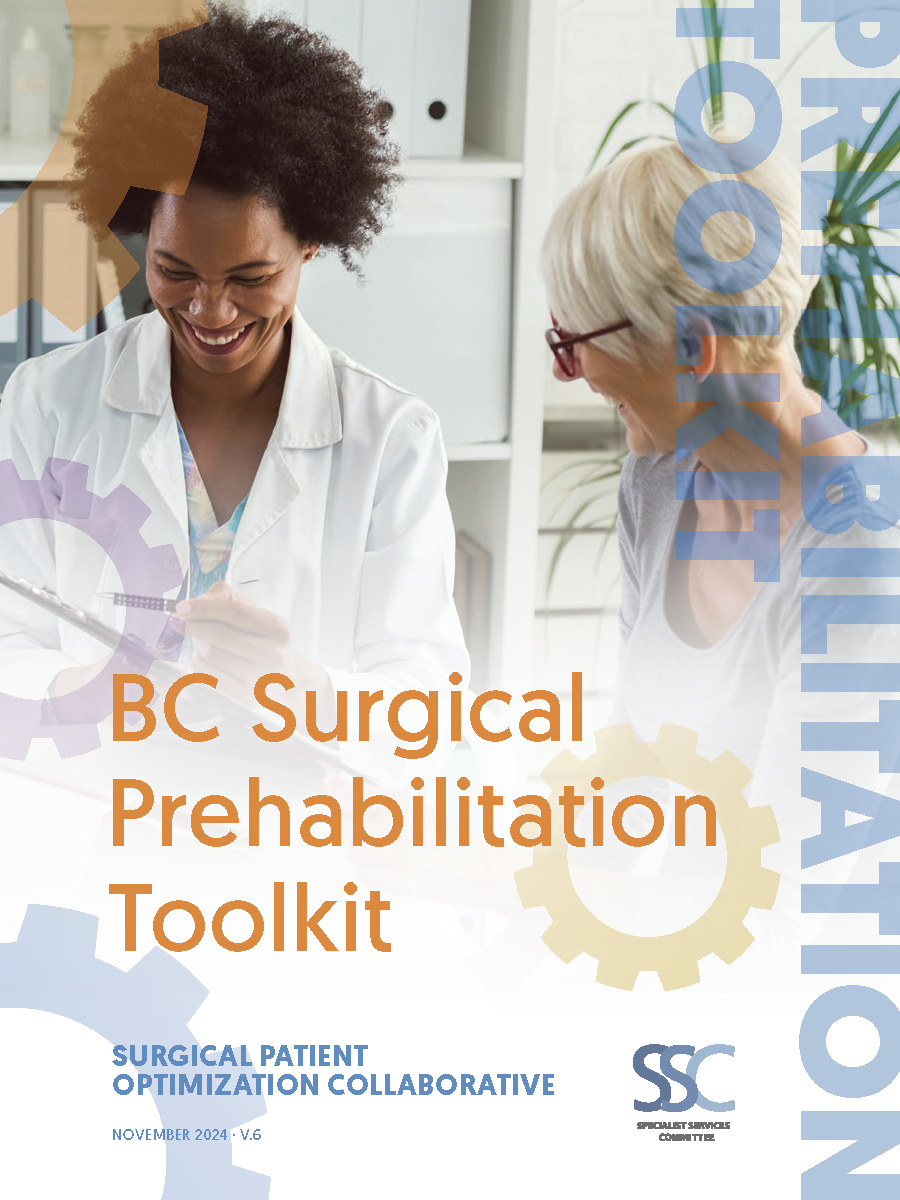
A pdf version of the toolkit can be accessed by clicking on the image below or each component can be explored through the menu options to the left or below.
Perioperative Care Alignment and Digital Screening (PCADS)
While SPOC and other research has demonstrated the positive impact of prehabilitation and optimization, typical pre-surgical journeys offer limited opportunity for prehab in the time leading up to surgery due to tight timelines and limited resources. A digital pre-surgical screening workflow has been identified as a critical piece to support prehabilitation and optimization workflows to improve the surgical system of care.
The Perioperative Care Alignment and Digital Screening (PCADS) project (2023-2024), developed a standardized Pre-Surgical Risk Assessment and Triage Tool (PRATT) to identify high-risk patients early in their preoperative wait time and provide standardized evidence-based recommendations for timely interventions like prehabilitation and optimization.
The PRATT is designed to collect patient health information and provide tailored recommendations in a streamlined manner early in the surgical timeline, allowing more time for patients to receive prehabilitation and optimization to improve their health prior to surgery. The clinical output includes:
- Validated perioperative risk scores
- Preoperative medication management recommendations
- Preoperative investigation recommendations
- Preoperative anesthesia consult recommendations
- Pre-Admission Clinic (PAC) nursing actions
- Flagged areas for prehabilitation and optimization prior to surgery
The PRATT currently exists as a database of patient questions and clinical output logic designed to be implemented digitally and integrate seamlessly with the recommendations included in the prehabilitation toolkit. The full PCADS report including the PRATT clinical content is available to any practitioners in British Columbia to incorporate into their prehabilitation workflows via the link below.
PCADS Final Report with PRATT Clinical Content
For a full list of contributors to the Prehabilitation Toolkit and PRATT, please click HERE.
Legal Disclaimer
We try very hard to keep this information accurate and up-to-date, but we cannot guarantee this. This information is intended as a resource and general guidance and is not meant to dictate the practice of clinicians. Clinicians are encourage to use the information at their own discretion based on the best interest of the patient. It cannot be used for any commercial or business purpose. Although we make reasonable efforts to ensure the accuracy of the information in these resources, we make no representations, warranties or guarantees, whether express or implied, that the information is accurate, complete or up to date. We do not exclude or limit in any way our liability to you where it would be unlawful to do so.
© 2025 Specialists Services Committee
This information may be copied for the purpose of producing information materials. Please quote this original source. If you wish to use part of this information in another publication, suitable acknowledgement must be given and the logos, branding, images, and icons removed. For more information, please contact us at sscbc@doctorsofbc.ca.
SSC. (2025). BC Surgical Prehabilitation Toolkit. https://sscbc.ca/surgical-prehab-toolkit