Jump to Navigation

What can we help you find today? Type what you’re looking for in the space below.

Close
  • About Us
    • Committee Members
    • Reports
  • What We Do
    • Community Based Specialists
    • Consultant Specialist Team Care
    • Facility Engagement
    • Health System Redesign
    • Physician Quality Improvement Initiative
    • Physician Leadership Development
    • UBC Sauder Physician Leadership Program
    • Specialists Well-Being Pilot (SWELL)
    • Perioperative Clinical Action Network (PCAN)
    • SSC Fees
  • News
    • Upcoming Events
    • SSC newsletters
    • Videos
  • Contact
  • The Exchange
  • FE Knowledge Sharing
  • Main Menu
  • search

Mental Wellbeing

Significant anxiety and depression are associated with increased postoperative pain, prolonged hospital length of stay, and hospital readmission, as well as many other postoperative complications (1,2). Preoperative education and expectation setting can help reduce postoperative anxiety, depression, and length of stay, and improve patient experiences and outcomes. (3,4)

Screening Tools

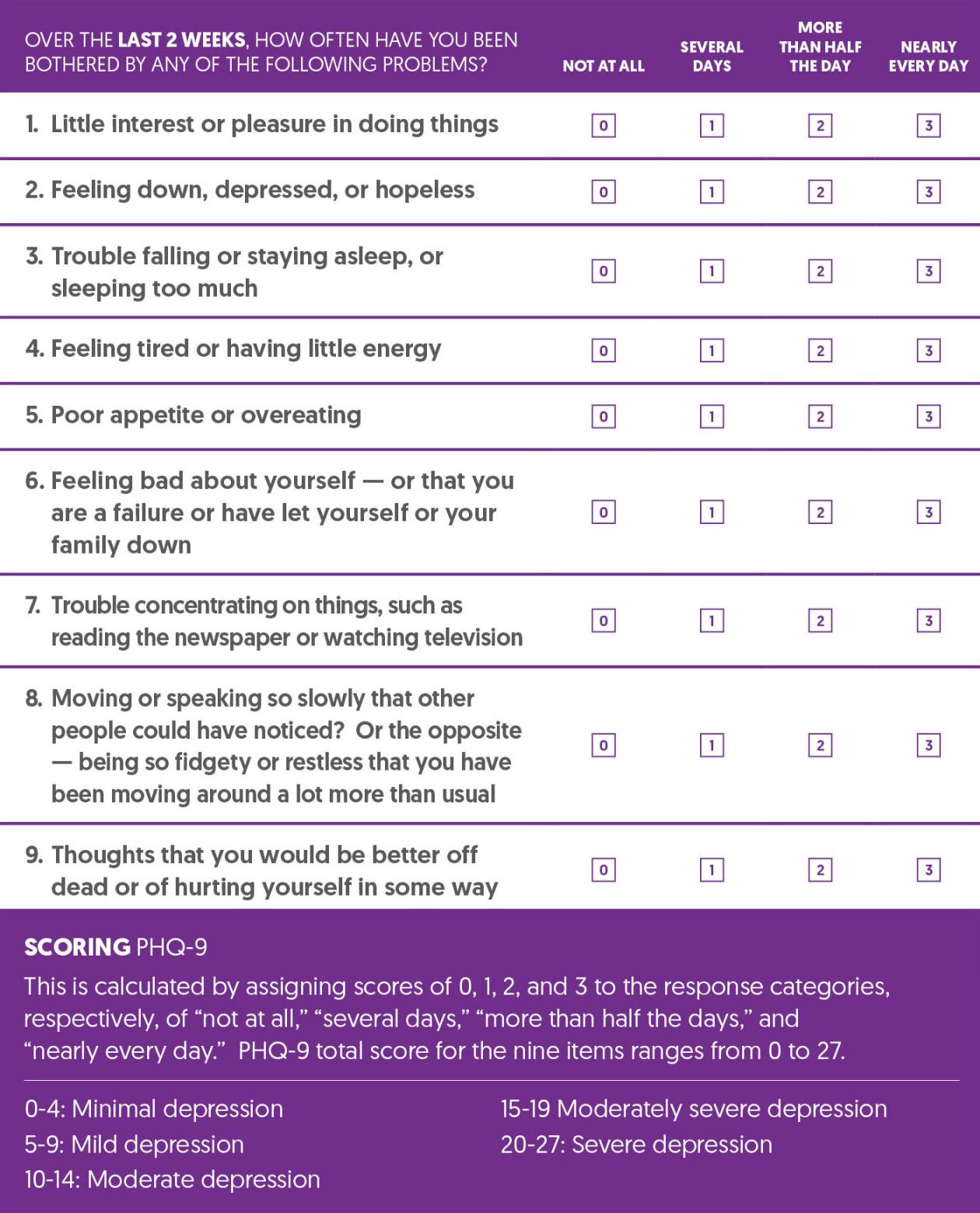
The Patient Health Questionnaire-2 (PHQ-2) is an initial screening tool for depression, comprising the first two questions of the Patient Health Questionnaire-9 (PHQ-9). A PHQ-2 score of 3 or more warrants completion of the PHQ-9. (5,6)

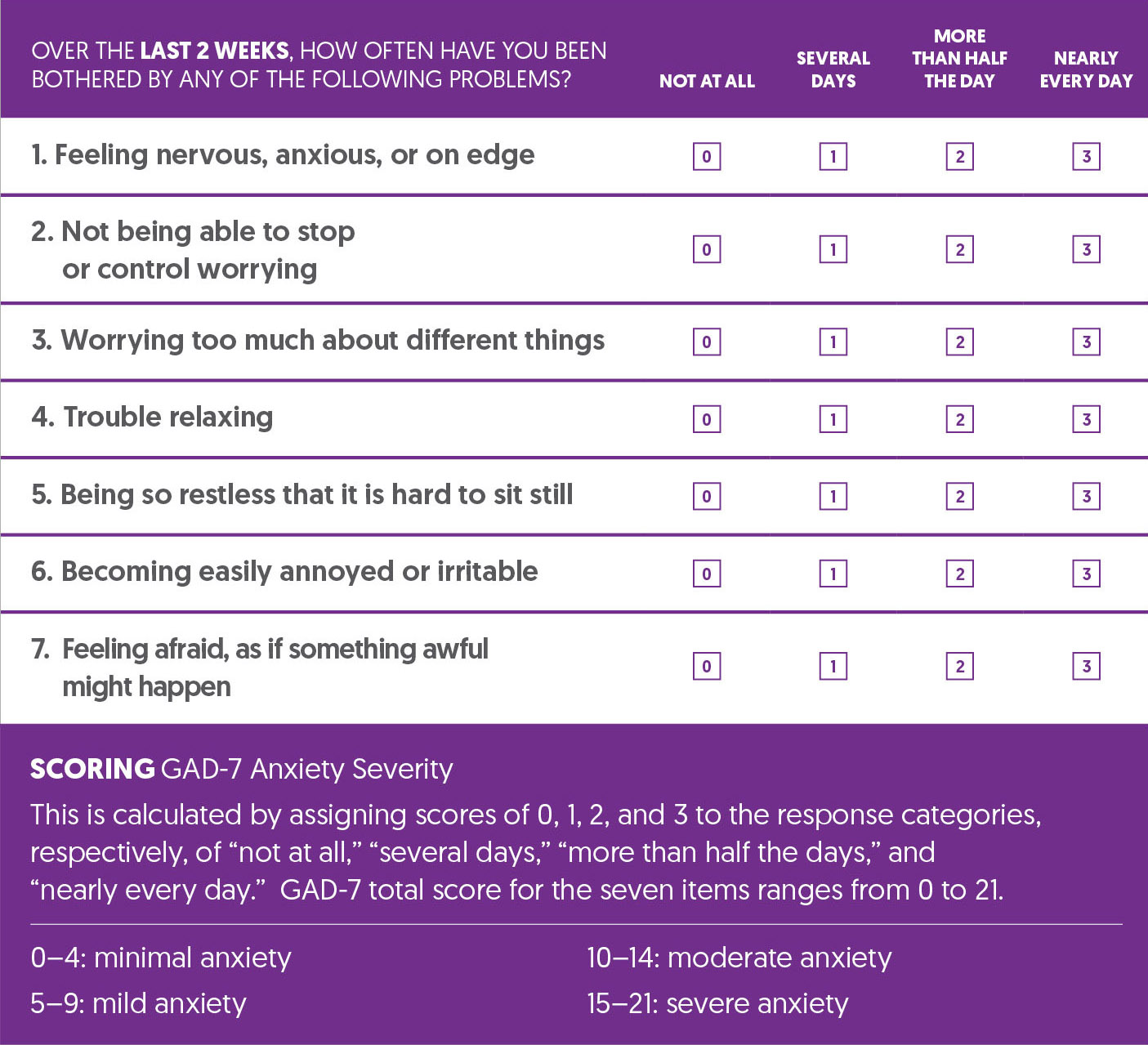
The General Anxiety Disorder-2 (GAD-2) is an initial screening tool for generalized anxiety disorder (GAD), comprising the first two questions of the General Anxiety Disorder-7 (GAD-7). A GAD-2 score of 3 or more warrants completion of the GAD-7 scale. (7)

While no scale is diagnostic, these tools are intended to help identify pre-surgical patients who may be experiencing more significant symptoms, who may benefit from targeted pre-surgical intervention.

Patient Health Questionnaire-9 (PHQ-9)
Generalized Anxiety Disorder-7 (GAD-7) Questionnaire
Prehabilitation and Optimization Algorithm
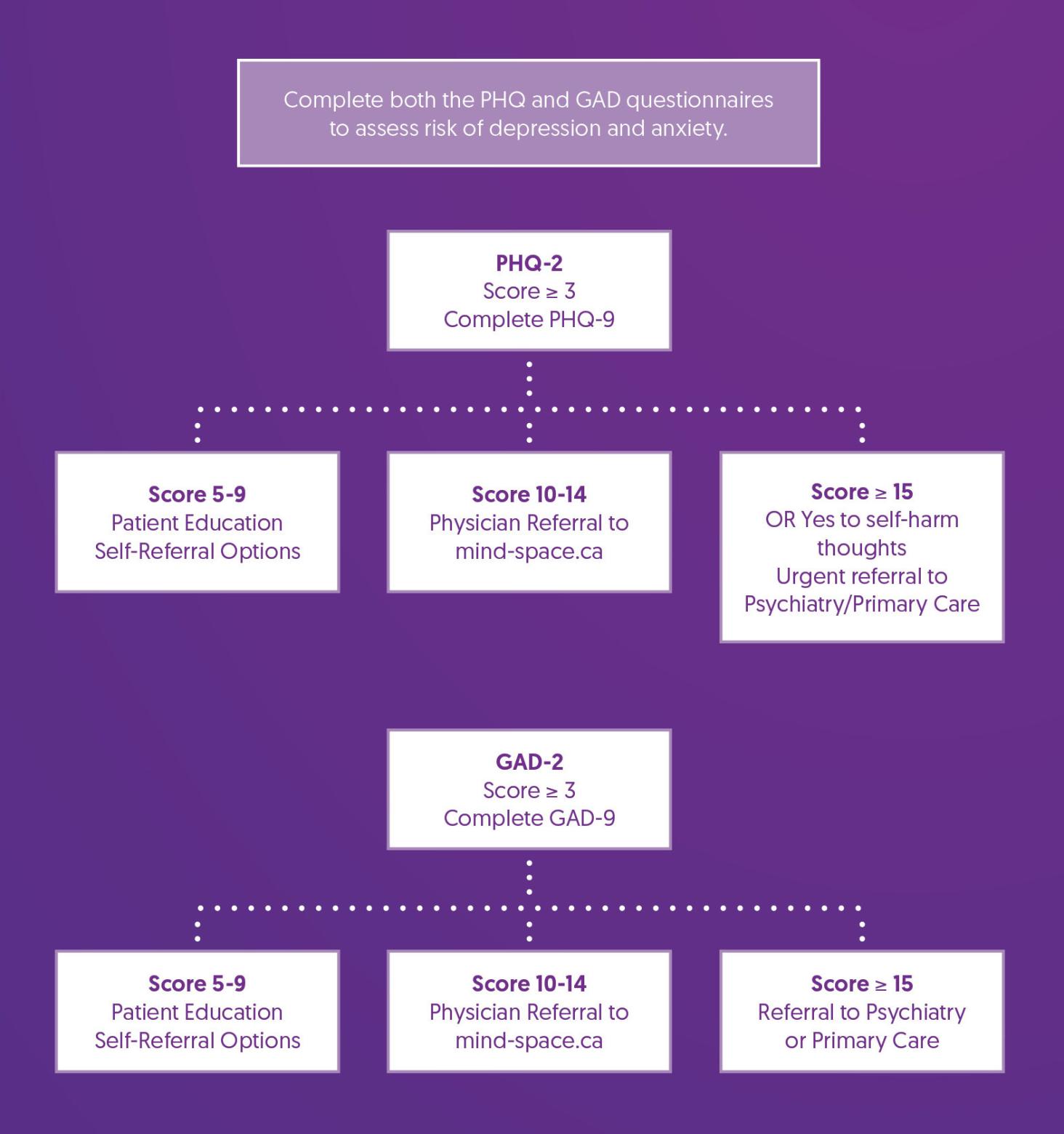
Prehabilitation and Optimization Recommendations

Patient Education
  • Set patient expectations for postoperative anxiety management
  • "Based on your responses, it sounds like you might be feeling anxious or experiencing low moods at times. Your mental wellbeing affects your ability to recover well after surgery. Other patients have found these resources to be helpful in the past.”
  • Refer to online patient resources
Self-Referral Options
  • Encourage patient to seek help from at least one of the following options:
    • Primary care appointment to discuss mental health (provide patient with their PHQ-9 and GAD-7 scores)
    • Help Starts Here or 211 for online/telephone access to local supports and resources
    • 310-6789 BC mental health and crisis response line
    • 988 national suicide crisis helpline
Physician-Referral Options
  • Mild to Moderate symptoms (PHQ-9 score: < 15): refer to mind-space.ca
  • Severe symptoms (PHQ-9 score: >= 15): refer to Psychiatry or Primary Care

References

1. Browne, J. A., Sandberg, B. F., D'Apuzzo, M. R., & Novicoff, W. M. (2014). Depression is associated with early postoperative outcomes following total joint arthroplasty: a nationwide database study. The Journal of arthroplasty, 29(3), 481–483. https://doi.org/10.1016/j.arth.2013.08.025

2. Geoffrion, R., Koenig, N. A., Zheng, M., Sinclair, N., Brotto, L. A., Lee, T., & Larouche, M. (2021). Preoperative depression and anxiety impact on inpatient surgery outcomes: A prospective cohort study. Annals of Surgery Open, 1(e049). https://doi.org/10.1097/AS9.0000000000000049

3. 10. Li, L., Li, S., Sun, Y., Zhang, S., Zhang, X., & Qu, H. (2021). Personalized Preoperative Education Reduces Perioperative Anxiety in Old Men with Benign Prostatic Hyperplasia: A Retrospective Cohort Study. Gerontology, 67(2), 177–183. https://doi.org/10.1159/000511913

4. Ng, S. X., Wang, W., Shen, Q., Toh, Z. A., & He, H. G. (2022). The effectiveness of preoperative education interventions on improving perioperative outcomes of adult patients undergoing cardiac surgery: a systematic review and meta-analysis. European journal of cardiovascular nursing, 21(6), 521–536. https://doi.org/10.1093/eurjcn/zvab123

5. Instructions for Patient Health Questionnaire (PHQ) and GAD-7 Measures. (n.d.). Retrieved August 26, 2024, from https://www.phqscreeners.com/images/sites/g/files/g10016261/f/201412/instructions.pdf

6. Kroenke, K., Spitzer, R. L., & Williams, J. B. (2003). The Patient Health Questionnaire-2: validity of a two-item depression screener. Medical care, 41(11), 1284–1292. https://doi.org/10.1097/01.MLR.0000093487.78664.3C

7. Plummer, F., Manea, L., Trepel, D., & McMillan, D. (2016). Screening for anxiety disorders with the GAD-7 and GAD-2: A systematic review and diagnostic meta-analysis. General Hospital Psychiatry, 39, 24-31. https://doi.org/10.1016/j.genhosppsych.2015.11.005

Goals of Care Surgical Prehabilitation Toolkit for Healthcare Providers Nutrition
  • Printer-friendly version

Surgical Prehabilitation Toolkit

  • Anemia
  • Cardiac Risk
  • Delirium
  • Frailty
  • Glycemic Control
  • Goals of Care
  • Mental Wellbeing
  • Nutrition
  • Obesity
  • Obstructive Sleep Apnea
  • Pain Management
  • Physical Activity
  • Smoking Cessation
  • Substance Use - Alcohol
  • Substance Use - Cannabis
  • Substance Use - Illicit Substances
  • Support After Surgery

About Us

  • Committee Members
  • Reports

SSC Fees

  • Advance Care Planning
  • Discharge Care Planning
  • Group Medical Visits (GMV)
  • Multidisciplinary Conferencing
  • Patient Follow-up Fees
  • Specialist Advice Fees
  • FAQs
  • Labour Market Adjustment Fees

News

  • Upcoming Events
  • SSC newsletters
  • Videos

General Contact

Specialist Services Committee
sscbc@doctorsofbc.ca
604-638-4853  

The Specialist Services Committee acknowledges that we work on the traditional, ancestral, and unceded territories of many different Indigenous Nations throughout British Columbia.

Acknowledging that we are on the traditional territories of First Nations communities is an expression of cultural humility and involves recognizing our duty and desire to support the provision of culturally safe care to First Nations, Inuit, and Métis people in BC. 

Government of BC   Doctors of BC

Specialist Services Committee © Doctors of BC

  • About Us
    • Committee Members
    • Reports
  • What We Do
    • Community Based Specialists
    • Consultant Specialist Team Care
    • Facility Engagement
    • Health System Redesign
    • Physician Quality Improvement Initiative
    • Physician Leadership Development
    • UBC Sauder Physician Leadership Program
    • Specialists Well-Being Pilot (SWELL)
    • Perioperative Clinical Action Network (PCAN)
    • SSC Fees
  • News
    • Upcoming Events
    • SSC newsletters
    • Videos
  • Contact
  • The Exchange
  • FE Knowledge Sharing
  • Main Menu
  • search