Jump to Navigation

What can we help you find today? Type what you’re looking for in the space below.

Close
  • About Us
    • Committee Members
    • Reports
  • What We Do
    • Community Based Specialists
    • Consultant Specialist Team Care
    • Facility Engagement
    • Health System Redesign
    • Physician Quality Improvement Initiative
    • Physician Leadership Development
    • UBC Sauder Physician Leadership Program
    • Specialists Well-Being Pilot (SWELL)
    • Perioperative Clinical Action Network (PCAN)
    • SSC Fees
  • News
    • Upcoming Events
    • SSC newsletters
    • Videos
  • Contact
  • The Exchange
  • FE Knowledge Sharing
  • Main Menu
  • search

Substance Use - Cannabis

Cannabis (marijuana) use may lead to increased anesthetic requirements, postoperative pain, opioid use after surgery, and nausea and vomiting. (1-3) Smoking cannabis increases the risk of pulmonary complications, cardiovascular complications (including postoperative myocardial infarction), and in-hospital mortality; it may also increase airway irritation, carboxyhemoglobin, and reduce oxygen-carrying capacity, similar to conventional cigarette smoking. (3-5)

Screening Tools

Cannabis Screening Questions:

Do you use Cannabis? If Yes:

  • How often?
  • How much do you use?
  • How are you using it? (e.g., smoking, vaping, tincture/oil, edibles, cream)
  • Have you ever had symptoms like headaches, anxiety, poor sleep, or stomach pain when you stopped using cannabis for a day or two (Cannabis Withdrawal Syndrome)?

Prehabilitation and Optimization Algorithm
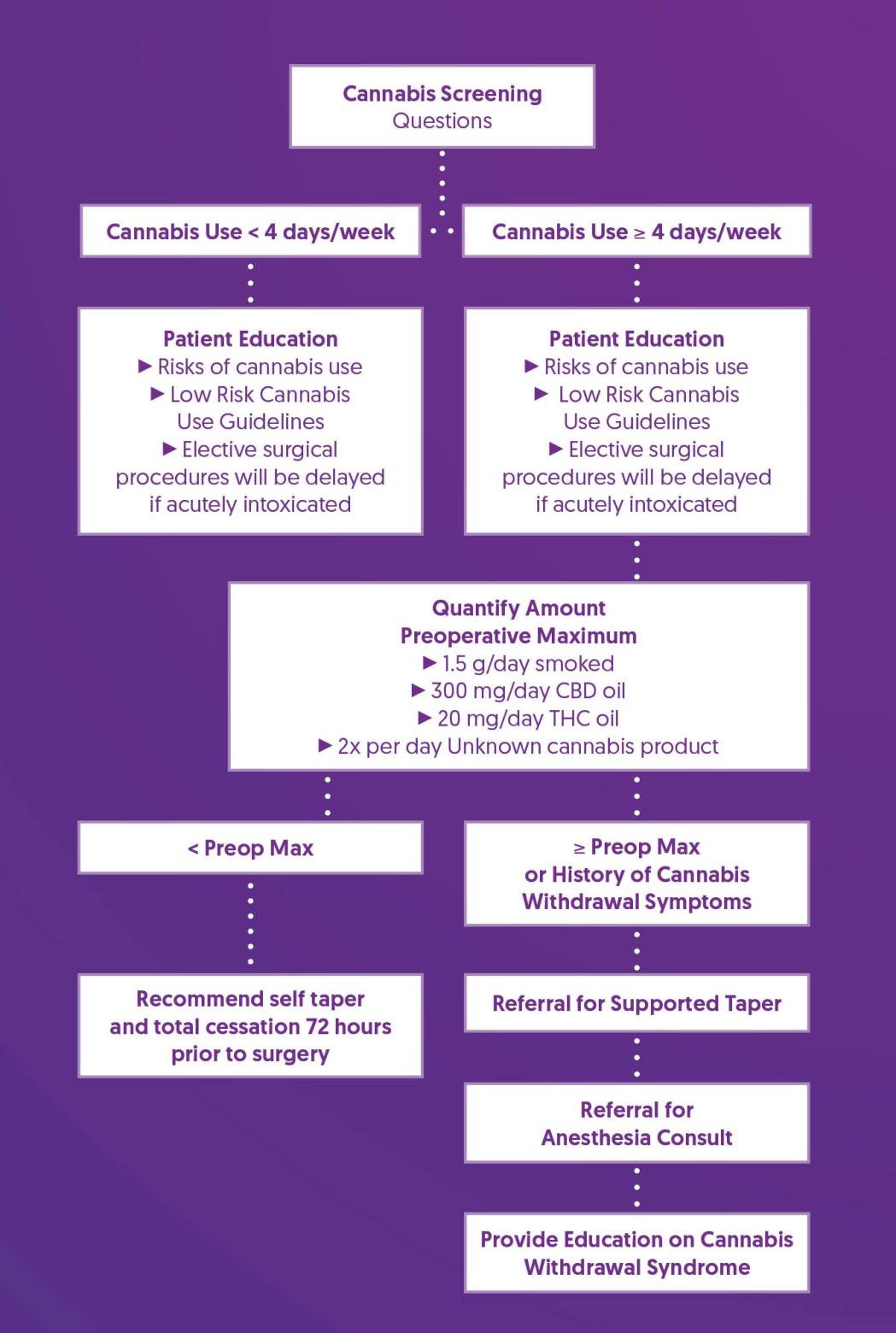
Prehabilitation and Optimization Recommendations

Patient Education
  • Advise patients on perioperative risks of cannabis use (1,2)
    • "Cannabis use puts you at higher risk of heart attacks and lung complications, as well as nausea and vomiting and increased pain after surgery.”
    • “It is best to stop using cannabis for at least 72 hours before surgery. This does not apply to creams.”
  • Advise patients that elective surgical procedures will be delayed if they are acutely intoxicated
  • Discuss Canada's Lower Risk Cannabis Use Guidelines (6):
    • Choose low-strength products, such as those with a lower THC content or a higher ratio of CBD to THC.
    • Avoid using synthetic cannabis products.
    • Smoking cannabis (for example, smoking a joint) is the most harmful way of using cannabis because it directly affects your lungs.
  • Refer to online patient resources
Recommend Self Taper
  • Lower amount every day over 7 days with total cessation 72 hours prior to surgery
  • “If you use a lot of cannabis on a daily basis you should slowly decrease the amount you use every day until you can stop for 72 hours without feeling unwell.”
  • Slow taper if experiencing symptoms of Cannabis Withdrawal Syndrome (CWS)
Referral for Supported Taper
  • Consider tapering to a goal of less than the recommended preoperative maximum (rather than complete cessation 72 hours preop)
  • Consider primary care, Addiction Medicine, or RACE line support
Referral for Anesthesia Consult
  • To develop effective pain management strategies and explore options for anesthesia and postoperative pain control, especially in moderate to severely invasive surgery
Provide Education on Cannabis Withdrawal Syndrome
  • Usually begins 1-2 days after cessation and lasts up to 3 weeks
  • Symptoms include: headaches, anxiety, poor sleep, stomach pain
  • Treatment:
    • Supportive counseling and psychoeducation
    • Consider referral for supported taper or suggest slower taper (10% reduction per day)
    • No medications are approved for medically assisted withdrawal, though some are used ‘off‐label’ in clinical practice.

References

1. Ladha, K. S., McLaren-Blades, A., Goel, A., Buys, M. J., Farquhar-Smith, P., Haroutounian, S., Kotteeswaran, Y., Kwofie, K., Le Foll, B., Lightfoot, N. J., Loiselle, J., Mace, H., Nicholls, J., Regev, A., Rosseland, L. A., Shanthanna, H., Sinha, A., Sutherland, A., Tanguay, R., Yafai, S., … Clarke, H. (2021). Perioperative Pain and Addiction Interdisciplinary Network (PAIN): consensus recommendations for perioperative management of cannabis and cannabinoid-based medicine users by a modified Delphi process. British journal of anaesthesia, 126(1), 304–318. https://doi.org/10.1016/j.bja.2020.09.026

2. Shah, S., Schwenk, E. S., Sondekoppam, R. V., Clarke, H., Zakowski, M., Rzasa-Lynn, R. S., Yeung, B., Nicholson, K., Schwartz, G., Hooten, W. M., Wallace, M., Viscusi, E. R., & Narouze, S. (2023). ASRA Pain Medicine consensus guidelines on the management of the perioperative patient on cannabis and cannabinoids. Regional anesthesia and pain medicine, 48(3), 97–117. https://doi.org/10.1136/rapm-2022-104013

3. Echeverria-Villalobos, M., Todeschini, A. B., Stoicea, N., Fiorda-Diaz, J., Weaver, T., & Bergese, S. D. (2019). Perioperative care of cannabis users: A comprehensive review of pharmacological and anesthetic considerations. Journal of clinical anesthesia, 57, 41–49. https://doi.org/10.1016/j.jclinane.2019.03.011

4. Tetrault, J. M., Crothers, K., Moore, B. A., Mehra, R., Concato, J., & Fiellin, D. A. (2007). Effects of marijuana smoking on pulmonary function and respiratory complications: a systematic review. Archives of internal medicine, 167(3), 221–228. https://doi.org/10.1001/archinte.167.3.221

5. Jeffers, A. M., Glantz, S., Byers, A. L., & Keyhani, S. (2024). Association of Cannabis Use With Cardiovascular Outcomes Among US Adults. Journal of the American Heart Association, 13(5), e030178. https://doi.org/10.1161/JAHA.123.030178

6. The Centre for Addiction and Mental Health. (2017). 10 Ways to Reduce Risks to Your Health When Using Cannabis. https://www.camh.ca/-/media/files/pdfs---reports-and-books---research/canadas-lower-risk-guidelines-cannabis-pdf.pdf

Substance Use - Alcohol Surgical Prehabilitation Toolkit for Healthcare Providers Substance Use - Illicit Substances
  • Printer-friendly version

Surgical Prehabilitation Toolkit

  • Anemia
  • Cardiac Risk
  • Delirium
  • Frailty
  • Glycemic Control
  • Goals of Care
  • Mental Wellbeing
  • Nutrition
  • Obesity
  • Obstructive Sleep Apnea
  • Pain Management
  • Physical Activity
  • Smoking Cessation
  • Substance Use - Alcohol
  • Substance Use - Cannabis
  • Substance Use - Illicit Substances
  • Support After Surgery

About Us

  • Committee Members
  • Reports

SSC Fees

  • Advance Care Planning
  • Discharge Care Planning
  • Group Medical Visits (GMV)
  • Multidisciplinary Conferencing
  • Patient Follow-up Fees
  • Specialist Advice Fees
  • FAQs
  • Labour Market Adjustment Fees

News

  • Upcoming Events
  • SSC newsletters
  • Videos

General Contact

Specialist Services Committee
sscbc@doctorsofbc.ca
604-638-4853  

The Specialist Services Committee acknowledges that we work on the traditional, ancestral, and unceded territories of many different Indigenous Nations throughout British Columbia.

Acknowledging that we are on the traditional territories of First Nations communities is an expression of cultural humility and involves recognizing our duty and desire to support the provision of culturally safe care to First Nations, Inuit, and Métis people in BC. 

Government of BC   Doctors of BC

Specialist Services Committee © Doctors of BC

  • About Us
    • Committee Members
    • Reports
  • What We Do
    • Community Based Specialists
    • Consultant Specialist Team Care
    • Facility Engagement
    • Health System Redesign
    • Physician Quality Improvement Initiative
    • Physician Leadership Development
    • UBC Sauder Physician Leadership Program
    • Specialists Well-Being Pilot (SWELL)
    • Perioperative Clinical Action Network (PCAN)
    • SSC Fees
  • News
    • Upcoming Events
    • SSC newsletters
    • Videos
  • Contact
  • The Exchange
  • FE Knowledge Sharing
  • Main Menu
  • search