Studies have reported an association between hyperglycemia and adverse infectious and cardiovascular outcomes after cardiac and noncardiac surgery. (1-5) Many studies recommend delaying elective surgery until HbA1c levels are below 8.5, recognizing that this may not be feasible for all patients and that such a cutoff is not currently supported by robust evidence. (6-10)
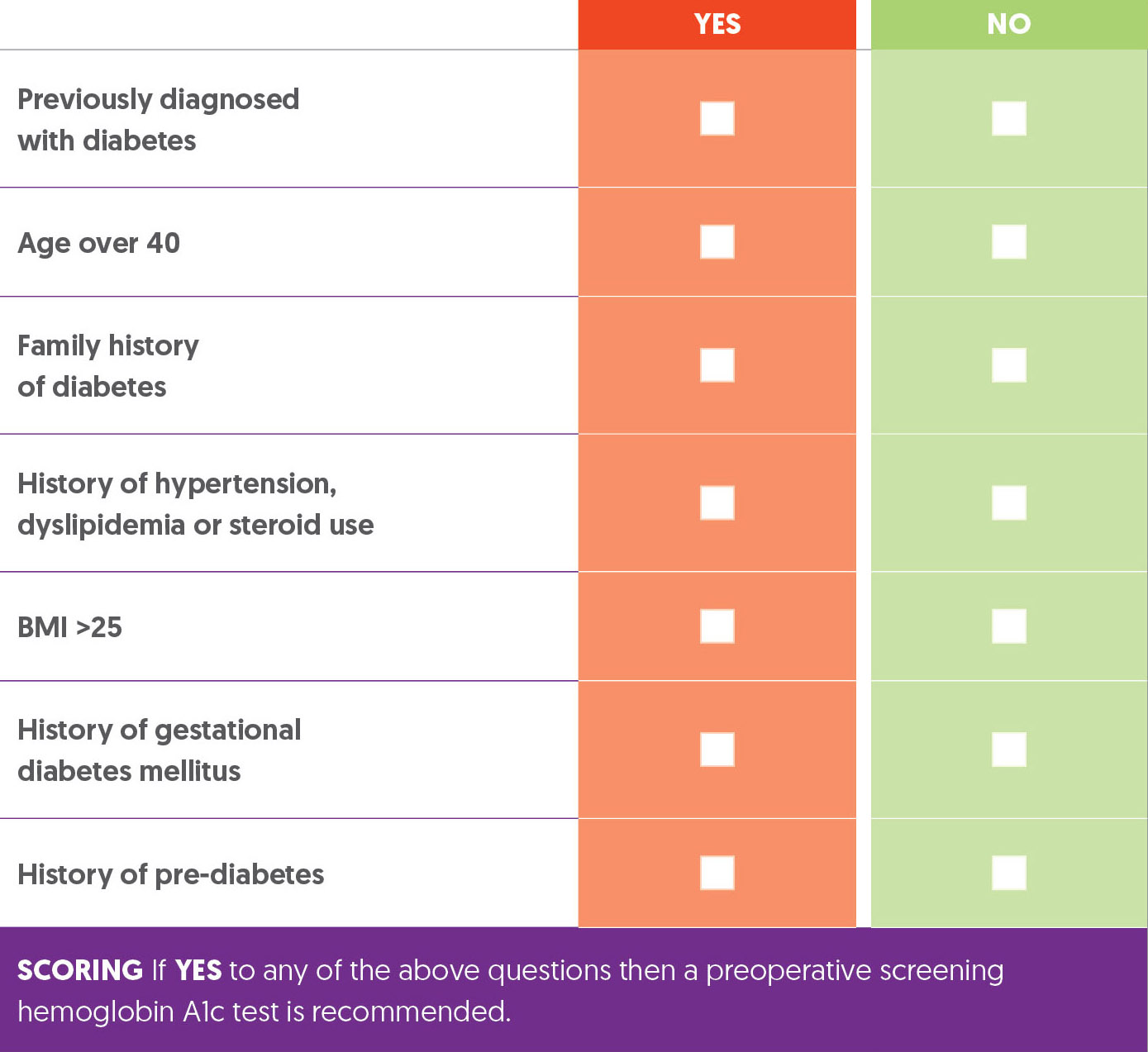
Screening Tools
Glycemic Control Screening Questions extrapolated from BC Guidelines for Diabetes Care (11). The CANRISK questionnaire is a validated risk tool for patients to self-assess their diabetes risk. (11)
Prehabilitation and Optimization Algorithm
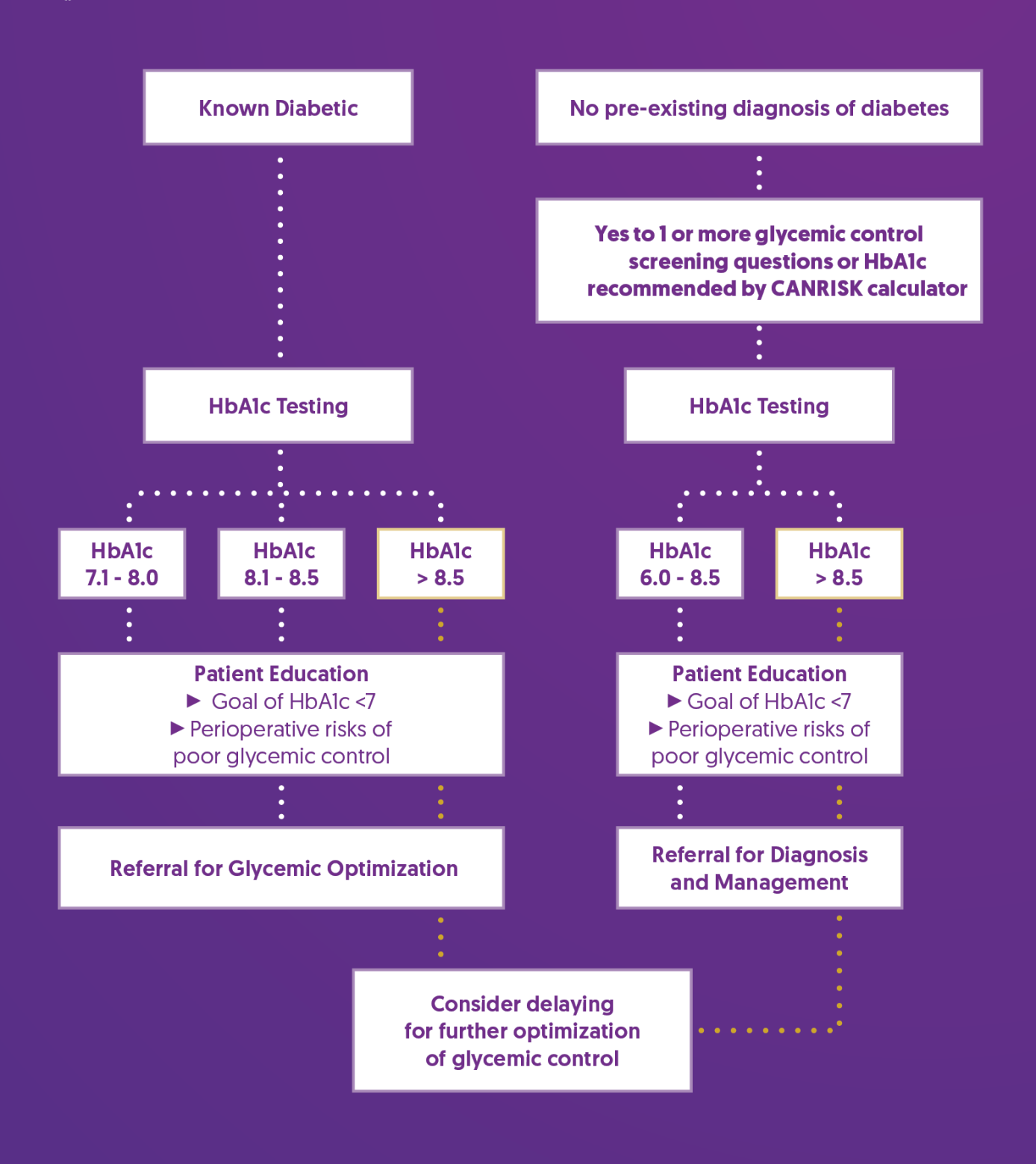
Prehabilitation and Optimization Recommendations
|
Patient Education |
|
| Referral for Diabetes Diagnoses and Management (No Pre-Existing Diabetes) |
|
| Referral for Glycemic Optimization (Known Diabetes) |
|
| Consider Delaying for Glycemic Optimization |
|
References
1. Gustafsson, U. O., Thorell, A., Soop, M., Ljungqvist, O., & Nygren, J. (2009). Haemoglobin A1c as a predictor of postoperative hyperglycaemia and complications after major colorectal surgery. The British journal of surgery, 96(11), 1358–1364. https://doi.org/10.1002/bjs.6724
2. Dronge, A. S., Perkal, M. F., Kancir, S., Concato, J., Aslan, M., & Rosenthal, R. A. (2006). Long-term glycemic control and postoperative infectious complications. Archives of surgery (Chicago, Ill. : 1960), 141(4), 375–380. https://doi.org/10.1001/archsurg.141.4.375
3. Han, H. S., & Kang, S. B. (2013). Relations between long-term glycemic control and postoperative wound and infectious complications after total knee arthroplasty in type 2 diabetics. Clinics in orthopedic surgery, 5(2), 118–123. https://doi.org/10.4055/cios.2013.5.2.118
4. Kwon, S., Thompson, R., Dellinger, P., Yanez, D., Farrohki, E., & Flum, D. (2013). Importance of perioperative glycemic control in general surgery: a report from the Surgical Care and Outcomes Assessment Program. Annals of surgery, 257(1), 8–14. https://doi.org/10.1097/SLA.0b013e31827b6bbc
5. Noordzij, P. G., Boersma, E., Schreiner, F., Kertai, M. D., Feringa, H. H., Dunkelgrun, M., Bax, J. J., Klein, J., & Poldermans, D. (2007). Increased preoperative glucose levels are associated with perioperative mortality in patients undergoing noncardiac, nonvascular surgery. European journal of endocrinology, 156(1), 137–142. https://doi.org/10.1530/eje.1.02321
6. ElSayed, N. A., Aleppo, G., Aroda, V. R., Bannuru, R. R., Brown, F. M., Bruemmer, D., Collins, B. S., Hilliard, M. E., Isaacs, D., Johnson, E. L., Kahan, S., Khunti, K., Leon, J., Lyons, S. K., Perry, M. L., Prahalad, P., Pratley, R. E., Seley, J. J., Stanton, R. C., Gabbay, R. A., … on behalf of the American Diabetes Association (2023). 16. Diabetes Care in the Hospital: Standards of Care in Diabetes-2023. Diabetes care, 46(Suppl 1), S267–S278. https://doi.org/10.2337/dc23-S016
7. Membership of the Working Party, Barker, P., Creasey, P. E., Dhatariya, K., Levy, N., Lipp, A., Nathanson, M. H., Penfold, N., Watson, B., & Woodcock, T. (2015). Peri-operative management of the surgical patient with diabetes 2015: Association of Anaesthetists of Great Britain and Ireland. Anaesthesia, 70(12), 1427–1440. https://doi.org/10.1111/anae.13233
8. Halvorsen, S., Mehilli, J., Cassese, S., Hall, T. S., Abdelhamid, M., Barbato, E., De Hert, S., de Laval, I., Geisler, T., Hinterbuchner, L., Ibanez, B., Lenarczyk, R., Mansmann, U. R., McGreavy, P., Mueller, C., Muneretto, C., Niessner, A., Potpara, T. S., Ristić, A., Sade, L. E., Schirmer, H., Schüpke, S., Sillesen, H., Skulstad, H., Torracca, L., Tutarel, O., Van Der Meer, P., Wojakowski, W., Zacharowski, K., ESC Scientific Document Group. (2022). 2022 ESC Guidelines on cardiovascular assessment and management of patients undergoing non-cardiac surgery. European heart journal, 43(39), 3826–3924. https://doi.org/10.1093/eurheartj/ehac270
9. Rajan, N., Duggan, E. W., Abdelmalak, B. B., Butz, S., Rodriguez, L. V., Vann, M. A., & Joshi, G. P. (2024). Society for Ambulatory Anesthesia Updated Consensus Statement on Perioperative Blood Glucose Management in Adult Patients With Diabetes Mellitus Undergoing Ambulatory Surgery. Anesthesia and analgesia, 139(3), 459–477. https://doi.org/10.1213/ANE.0000000000006791
10. Giori, N. J., Ellerbe, L. S., Bowe, T., Gupta, S., & Harris, A. H. (2014). Many diabetic total joint arthroplasty candidates are unable to achieve a preoperative hemoglobin A1c goal of 7% or less. The Journal of bone and joint surgery. American volume, 96(6), 500–504. https://doi.org/10.2106/JBJS.L.01631
11. Guidelines and Protocols Advisory Committee. (2021). Diabetes Care. British Columbia Medical Services Commission. https://www2.gov.bc.ca/gov/content/health/practitioner-professional-resources/bc-guidelines/diabetes
12. Diabetes Canada. (n.d.). Individualizing your patient’s A1C target. Retrieved October 27, 2024, from https://guidelines.diabetes.ca/reduce-complications/a1ctarget