Jump to Navigation

What can we help you find today? Type what you’re looking for in the space below.

Close
  • About Us
    • Committee Members
    • Reports
  • What We Do
    • Community Based Specialists
    • Consultant Specialist Team Care
    • Facility Engagement
    • Health System Redesign
    • Physician Quality Improvement Initiative
    • Physician Leadership Development
    • UBC Sauder Physician Leadership Program
    • Specialists Well-Being Pilot (SWELL)
    • Perioperative Clinical Action Network (PCAN)
    • SSC Fees
  • News
    • Upcoming Events
    • SSC newsletters
    • Videos
  • Contact
  • The Exchange
  • FE Knowledge Sharing
  • Main Menu
  • search

Smoking Cessation

Cigarette smoking is a risk factor for perioperative pulmonary, cardiovascular, bleeding and wound healing complications. (1,2) There is some evidence that vaping (or the use of e-cigarettes) is also associated with these complications. (3) The likelihood that quit-motivated patients can abstain from smoking is increased by use of nicotine replacement therapy (NRT). (4)

Screening Tools

Screening Questions:

  • Do you currently use products that contain tobacco or nicotine? (e.g., smoking cigarettes or e-cigarettes, vaping nicotine, or chewing tobacco)
  • If Yes, what type of tobacco/nicotine product?
  • If cigarettes, how many packs/day? If other, how much & how often?

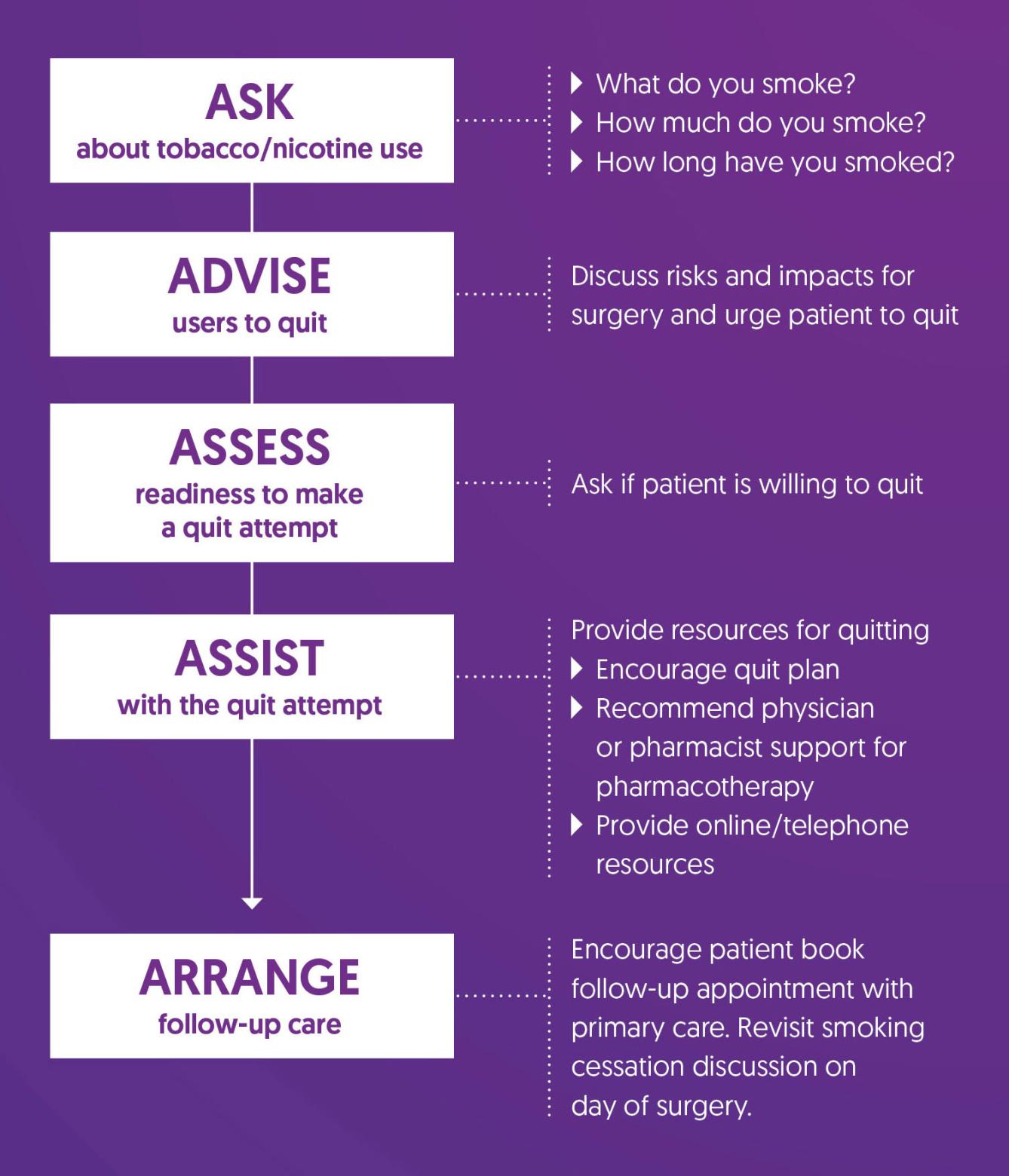
Prehabilitation and Optimization Algorithm
Prehabilitation and Optimization Recommendations

Patient Education

5 A’s Algorithm for Smoking Cessation (5).

  • ASK about tobacco/nicotine use
    • See screening questions
  • ADVISE to quit
    • Strongly urge all tobacco users to quit in a clear, strong, personalized manner.
    • "It is extremely important for you to quit smoking before surgery. Smoking and vaping have a huge impact on your heart and lung health and increase the risk of complications after surgery. Quitting or cutting back on smoking before surgery can:
      • lower your risk of getting pneumonia after surgery,
      • reduce your risk of having a heart attack during/after surgery,
      • speed up your healing after surgery, which reduces your risk of infection."
  • ASSESS readiness to make a quit attempt
    • “Are you willing to try to quit before surgery?”
  • ASSIST with the quit attempt
    • “Stopping smoking is not solely about willpower. Your body may be addicted to or dependent on nicotine and quitting can be difficult.”
    • Quit Plan: Encourage patients to set a quit date, tell family/friends, remove tobacco products from the environment, plan for withdrawal symptoms and cravings
    • Recommend pharmacotherapies (6):  Medications & Nicotine Replacement Therapy can increase smoking cessation success and reduce withdrawal symptoms (e.g., patch, gum, sprays, or oral medication). Family doctors or pharmacists are able to arrange therapies and ensure these therapies are covered financially through PharmaCare. Refer to online patient resources for covered therapies.
    • Provide resources for quitting: (6)
      • Quit Now
      • Healthlink or *211 to access support through live chats, telephone and connection with local smoking cessation resources.
      • Online patient resources
  • ARRANGE follow-up care
    • See referral for follow-up below
Referral for Follow-up
  • Outpatient follow-up:
    • Encourage patients to schedule follow-up with their primary care provider for 2 weeks time to discuss progress.
  • Day of Surgery - revisit smoking cessation:
    • If still smoking: Normalize that lapses are very common and reassure that stopping smoking is not solely about willpower. Many people require more than one attempt. Reinforce the benefits of smoking cessation postoperatively, and offer further resources if appropriate (such as pharmacotherapy if it was not utilized with last quit attempt).

References

1. Eliasen, M., Grønkjær, M., Skov-Ettrup, L. S., Mikkelsen, S. S., Becker, U., Tolstrup, J. S., & Flensborg-Madsen, T. (2013). Preoperative alcohol consumption and postoperative complications: a systematic review and meta-analysis. Annals of surgery, 258(6), 930–942. https://doi.org/10.1097/SLA.0b013e3182988d59

2. Turan, A., Mascha, E., Roberman, D., Turner, P. L., You, J., Kurz, A., Sessler, D. I., Saager, L. (2011). Smoking and Perioperative Outcomes. Anesthesiology, 114(4), 837-846. https://doi.org/10.1098/ALN.0b013e318210f560

3. Rusy, D., Honkanen, A., Landrigan-Ossar, M. F., Chatterjee, D., Schwartz, L., Lalwani, K., Dollar, J., Clark, R., Diaz, C. D., Deutsch, N., Warner, D. O., Soriano, S. G., (2021). Vaping and E-Cigarette Use in Children and Adolescents: Implications on Perioperative Care from the American Society of Anesthesiologists Committee on Pediatric Anesthesia, Society for Pediatric Anesthesia, and American Academy of Pediatrics Section on Anesthesiology and Pain Medicine. Anesthesia & Analgesia, 133(3), 562-568. https://doi.org/10.1213/ANE.0000000000005519

4. Bush, K., Kivlahan, D. R., McDonell, M. B., Fihn, S. D., & Bradley, K. A. (1998). The AUDIT alcohol consumption questions (AUDIT-C): an effective brief screening test for problem drinking. Ambulatory Care Quality Improvement Project (ACQUIP). Alcohol Use Disorders Identification Test. Archives of internal medicine, 158(16), 1789–1795. https://doi.org/10.1001/archinte.158.16.1789

5. Fiore, M. C., Jaén, C. R., Baker, T. B., et al. (2008). Treating Tobacco Use and Dependence: 2008 Update. Clinical Practice Guideline. U.S. Department of Health and Human Services, Public Health Service. https://www.ahrq.gov/sites/default/files/wysiwyg/professionals/clinicians-providers/guidelines-recommendations/tobacco/clinicians/update/treating_tobacco_use08.pdf

6. Government of British Columbia (n.d.). Smoking Cessation Program – information for health professionals. Retrieved October 18, 2024, from https://www2.gov.bc.ca/gov/content/health/practitioner-professional-resources/pharmacare/pharmacies/smoking-cessation-program-for-health-professionals

Physical Activity Surgical Prehabilitation Toolkit for Healthcare Providers Substance Use - Alcohol
  • Printer-friendly version

Surgical Prehabilitation Toolkit

  • Anemia
  • Cardiac Risk
  • Delirium
  • Frailty
  • Glycemic Control
  • Goals of Care
  • Mental Wellbeing
  • Nutrition
  • Obesity
  • Obstructive Sleep Apnea
  • Pain Management
  • Physical Activity
  • Smoking Cessation
  • Substance Use - Alcohol
  • Substance Use - Cannabis
  • Substance Use - Illicit Substances
  • Support After Surgery

About Us

  • Committee Members
  • Reports

SSC Fees

  • Advance Care Planning
  • Discharge Care Planning
  • Group Medical Visits (GMV)
  • Multidisciplinary Conferencing
  • Patient Follow-up Fees
  • Specialist Advice Fees
  • FAQs
  • Labour Market Adjustment Fees

News

  • Upcoming Events
  • SSC newsletters
  • Videos

General Contact

Specialist Services Committee
sscbc@doctorsofbc.ca
604-638-4853  

The Specialist Services Committee acknowledges that we work on the traditional, ancestral, and unceded territories of many different Indigenous Nations throughout British Columbia.

Acknowledging that we are on the traditional territories of First Nations communities is an expression of cultural humility and involves recognizing our duty and desire to support the provision of culturally safe care to First Nations, Inuit, and Métis people in BC. 

Government of BC   Doctors of BC

Specialist Services Committee © Doctors of BC

  • About Us
    • Committee Members
    • Reports
  • What We Do
    • Community Based Specialists
    • Consultant Specialist Team Care
    • Facility Engagement
    • Health System Redesign
    • Physician Quality Improvement Initiative
    • Physician Leadership Development
    • UBC Sauder Physician Leadership Program
    • Specialists Well-Being Pilot (SWELL)
    • Perioperative Clinical Action Network (PCAN)
    • SSC Fees
  • News
    • Upcoming Events
    • SSC newsletters
    • Videos
  • Contact
  • The Exchange
  • FE Knowledge Sharing
  • Main Menu
  • search