Jump to Navigation

What can we help you find today? Type what you’re looking for in the space below.

Close
  • About Us
    • Committee Members
    • Reports
  • What We Do
    • Community Based Specialists
    • Consultant Specialist Team Care
    • Facility Engagement
    • Physician Quality Improvement Initiative
    • Physician Leadership Development
    • UBC Sauder Physician Leadership Program
    • Specialists Well-Being Pilot (SWELL)
    • Perioperative Clinical Action Network (PCAN)
    • SSC Fees
  • News
    • Upcoming Events
    • SSC newsletters
    • Videos
  • Contact
  • The Exchange
  • FE Knowledge Sharing
  • Main Menu
  • search

Anemia

Preoperative anemia is common, especially in orthopedic, gynecologic, and colorectal surgical patients. (1,2) “The presence of preoperative anemia, even if mild, has been associated with increased risk of red blood cell (RBC) transfusion and increased morbidity and mortality after surgery. In addition, transfusion of RBCs has been consistently associated with worsened clinical outcomes”. (3) Anemia is defined by the WHO as Hgb less than 130 g/L in men and less than 120 g/L in women. Because women are actually at a higher risk of transfusion (lower blood volume), blood management programs advocate for defining preoperative anemia as less than 130 g/L in both men and women.

Screening Tools

Preoperative hemoglobin (Hgb) is recommended to screen for anemia in patients when they are undergoing a procedure that would warrant a group and screen (e.g., revision arthroplasty, large volume prostatectomy, cardiothoracic, hepatobiliary, major spine and major urological procedures). Practitioners may also screen for anemia in patients where index of suspicion is high based on history and medical comorbidities. If a patient is found to be anemic, additional blood work is recommended to delineate the cause. 

Prehabilitation and Optimization Algorithm
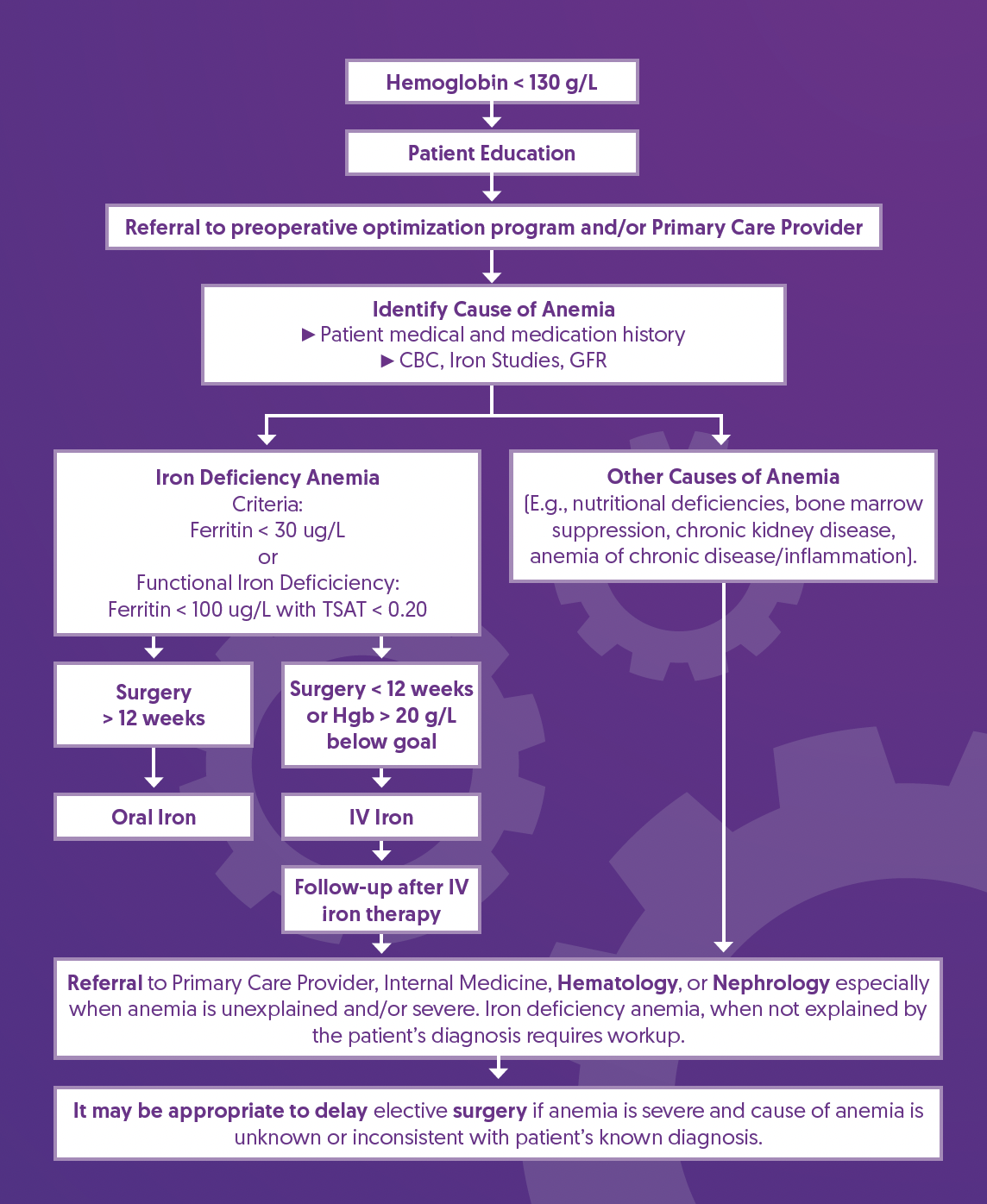
Prehabilitation and Optimization Recommendations

Patient Education
  • Communicate importance of optimizing hemoglobin before surgery to decrease perioperative risks
  • Refer to online patient resources
Consider Delaying Surgery
  • Consider postponing elective surgery to allow time for further investigation and treatment of anemia to support better surgical outcomes and reduce potential complications. This is particularly relevant when the anemia is unexpected or unexplained. Suggest communication with the surgical team.
  • Patients with a signed refusal for blood products undergoing high blood loss surgeries require special consideration. Consider multidisciplinary discussion and delaying surgery until hemoglobin goal is reached.
Referral to Preoperative Program and/or Primary Care Provider
  • In addition to treatment of anemia, patients with unexpected or unexplained anemia require further medical  workup for investigation and treatment.  This is particularly critical for patients with unexplained iron deficiency anemia, as they may need further evaluation to rule out serious conditions like gastrointestinal cancers.

Identify Cause of Anemia
  • Past medical history including bleeding history, medication history, and investigation history.
  • Bloodwork: CBC with differential iron studies (ferritin, transferrin saturation (Tsat), serum iron, total iron binding capacity), GFR, CRP, B12.
  • Which patients require treatment? High blood loss surgeries or operations where group and screen are routinely required, such as: revision/bilateral arthroplasty, large volume prostatectomy and major urological procedures, major gynaecology, open bowel resection/general surgery or hepatobiliary, cardiothoracic, multilevel spine.
  • Other situations where treatment should be considered:
    • Patients with anemia undergoing minor procedures.
    • Patients with iron deficiency with normal hemoglobin, particularly if about to undergo major surgery.
Treat Iron Deficiency Anemia
  • Criteria: Ferritin < 30 ng/L or Ferritin 30-100 ng/L and transferrin saturation < 0.20
  • If surgery > 12 weeks away: oral iron (e.g., ferrous fumarate 300 mg PO every other night with 600-1200 mg vitamin C (4)); recheck Hgb after one month
  • If surgery < 12 weeks away or Hgb > 20g/L below goal: IV iron
    • Dosing: Iron deficit can be estimated using the Ganzoni formula
    • Standardized dosing: Iron isomaltoside 1000-1500 mg (1-2 doses) or Iron sucrose 900-1500 mg (3-5 doses)
Follow-up After IV Iron Therapy
  • Expected duration of iron therapy:
    • Oral iron requires a minimum of 12 weeks to determine effect.
    • IV iron begins to take effect within 10-14 days, with an increase of up to 10g/L per week.
    • Goal: Hgb > 130g/L. This is unachievable in many patients given the timing of surgery and logistics of treatment. Clinical judgement is required as to when maximum benefit has been achieved/when to proceed.
  • ​​​​​​​​​​​​​​​​​​​​​​​​​​​​Follow-up bloodwork should be arranged 3-4 weeks post IV iron and 3 months post oral iron initiative to assess therapy. A preoperative CBC is recommended.
  • Patients undergoing major surgery or those that are iron deficient postoperatively may benefit from oral iron once the surgical period is over and the patient has recovered (oral iron not effective in the context of inflammation, so not recommended immediately postoperatively).
Referral to Hematology, Nephrology, or Internal Medicine
  • For other causes of anemia (e.g., nutritional deficiencies, bone marrow suppression, chronic kidney disease, anemia of chronic disease/inflammation), or if the patient shows an inadequate response to iron treatment, consider referring the patient to a subspecialist physician for further management.

References

1. Muñoz, M., Laso-Morales, M. J., Gómez-Ramírez, S., Cadellas, M., Núñez-Matas, M. J., & García-Erce, J. A. (2017). Pre-operative haemoglobin levels and iron status in a large multicentre cohort of patients undergoing major elective surgery. Anaesthesia, 72(7), 826–834. https://doi.org/10.1111/anae.13840

2. Baron, D. M., Hochrieser, H., Posch, M., Metnitz, B., Rhodes, A., Moreno, R. P., Pearse, R. M., Metnitz, P., European Surgical Outcomes Study (EuSOS) group for Trials Groups of European Society of Intensive Care Medicine, & European Society of Anaesthesiology (2014). Preoperative anaemia is associated with poor clinical outcome in non-cardiac surgery patients. British journal of anaesthesia, 113(3), 416–423. https://doi.org/10.1093/bja/aeu098

3. Shander, A., Corwin, H. L., Meier, J., Auerbach, M., Bisbe, E., Blitz, J., Erhard, J., Faraoni, D., Farmer, S. L., Frank, S. M., Girelli, D., Hall, T., Hardy, J. F., Hofmann, A., Lee, C. K., Leung, T. W., Ozawa, S., Sathar, J., Spahn, D. R., Torres, R., … Muñoz, M. (2023). Recommendations From the International Consensus Conference on Anemia Management in Surgical Patients (ICCAMS). Annals of surgery, 277(4), 581–590. https://doi.org/10.1097/SLA.0000000000005721

4. BCGuidelines.ca. Iron Deficiency – Diagnosis and Management (2019) Appendix A: Oral Iron Formulations and Adult Doses. https://www2.gov.bc.ca/assets/gov/health/practitioner-pro/bc-guidelines/...


Surgical Prehabilitation Toolkit for Healthcare Providers Surgical Prehabilitation Toolkit for Healthcare Providers Cardiac Risk
  • Printer-friendly version

Surgical Prehabilitation Toolkit

  • Anemia
  • Cardiac Risk
  • Delirium
  • Frailty
  • Glycemic Control
  • Goals of Care
  • Mental Wellbeing
  • Nutrition
  • Obesity
  • Obstructive Sleep Apnea
  • Pain Management
  • Physical Activity
  • Smoking Cessation
  • Substance Use - Alcohol
  • Substance Use - Cannabis
  • Substance Use - Illicit Substances
  • Support After Surgery

What’s New

Aug 11, 2026

Physician Quality Improvement: Celebrating Level 3 Cohort 8!

Photo of PQI alums at the Summit
Jul 16, 2026

Coming together for Physician Quality Improvement

Colourful artwork featuring an illustration of a narwhal and feather
Jun 1, 2026

Celebrating Indigenous culture: past, present, and future

Photo of doctor at a laptop
May 6, 2026

Transitioning off the Private Physician Network

View all News

About Us

  • Committee Members
  • Reports

SSC Fees

  • Advance Care Planning
  • Discharge Care Planning
  • Group Medical Visits (GMV)
  • Multidisciplinary Conferencing
  • Patient Follow-up Fees
  • Specialist Advice Fees
  • FAQs
  • Labour Market Adjustment Fees

News

  • Upcoming Events
  • SSC newsletters
  • Videos

General Contact

Specialist Services Committee
sscbc@doctorsofbc.ca
604-638-4853  

The land from which the Joint Collaborative Committees—a partnership between Doctors of BC and the BC government—operate and support physicians is the traditional territories of the Coast Salish peoples, including the xʷməθkʷəy̓əm (Musqueam), Sḵwx̱wú7mesh (Squamish), and səlilwətaɬ (Tsleil-Waututh) Nations, whose historical relationship with the land continues today.

For the Joint Collaborative Committees, acknowledging the land is an expression of cultural humility that involves recognizing our commitment to support the provision of culturally safe care to First Nations, Inuit, and Métis people in BC.

Government of BC   Doctors of BC

Specialist Services Committee © Doctors of BC

  • About Us
    • Committee Members
    • Reports
  • What We Do
    • Community Based Specialists
    • Consultant Specialist Team Care
    • Facility Engagement
    • Physician Quality Improvement Initiative
    • Physician Leadership Development
    • UBC Sauder Physician Leadership Program
    • Specialists Well-Being Pilot (SWELL)
    • Perioperative Clinical Action Network (PCAN)
    • SSC Fees
  • News
    • Upcoming Events
    • SSC newsletters
    • Videos
  • Contact
  • The Exchange
  • FE Knowledge Sharing
  • Main Menu
  • search