Jump to Navigation

What can we help you find today? Type what you’re looking for in the space below.

Close
  • About Us
    • Committee Members
    • Reports
  • What We Do
    • Community Based Specialists
    • Consultant Specialist Team Care
    • Facility Engagement
    • Physician Quality Improvement Initiative
    • Physician Leadership Development
    • UBC Sauder Physician Leadership Program
    • Specialists Well-Being Pilot (SWELL)
    • Perioperative Clinical Action Network (PCAN)
    • SSC Fees
  • News
    • Upcoming Events
    • SSC newsletters
    • Videos
  • Contact
  • The Exchange
  • FE Knowledge Sharing
  • Main Menu
  • search

Obstructive Sleep Apnea

Obstructive sleep apnea (OSA) is a chronic medical condition that is commonly undiagnosed. The most common form of sleep-disordered breathing, it is characterized by recurring transient obstructions of airflow that occur exclusively during sleep. OSA is associated with increased risk of perioperative complications, including postoperative respiratory failure, cardiac events, and ICU transfer, and should be identified and treated as early as possible to help reduce this risk. (1-7)

Screening Tools

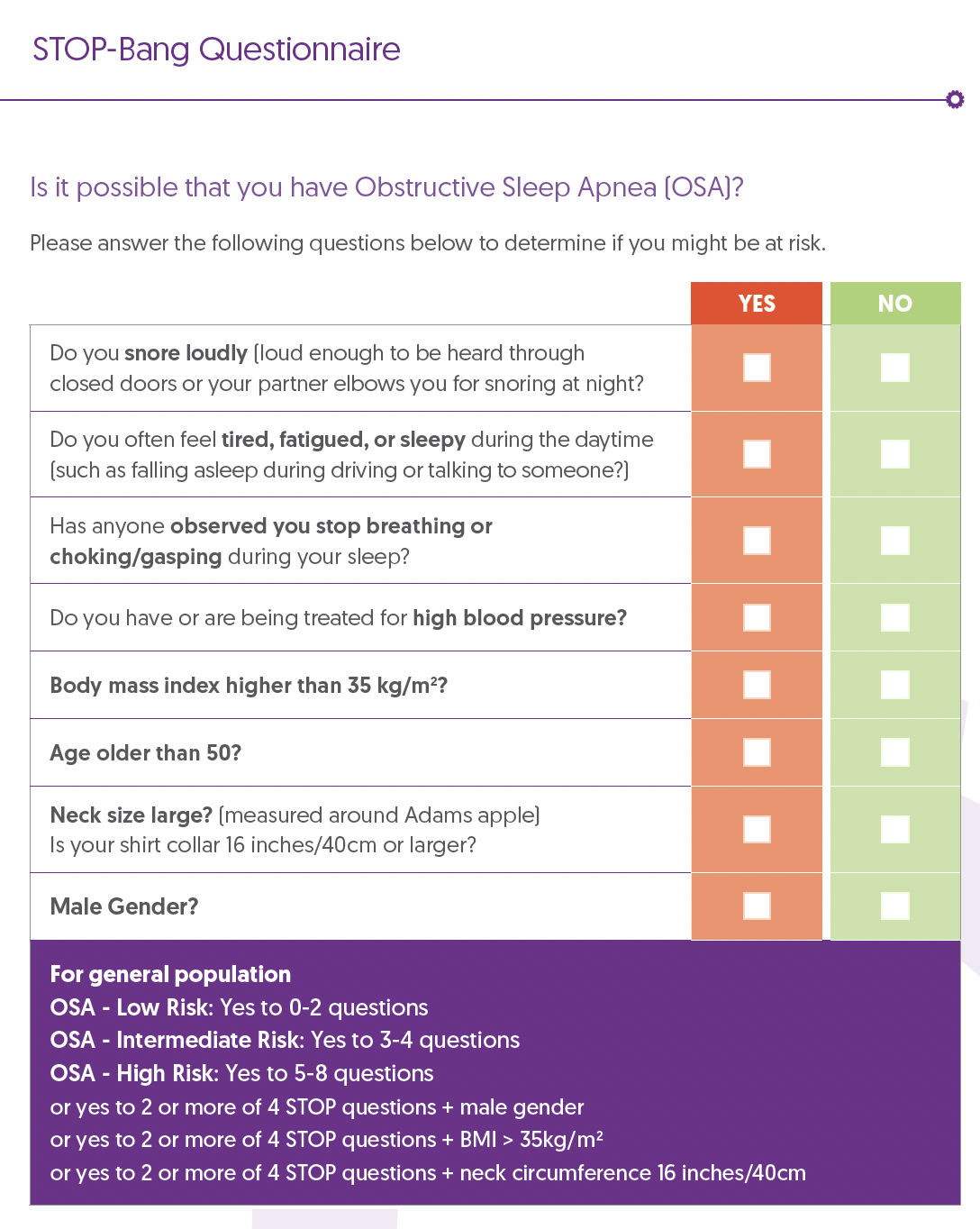
The STOP-Bang questionnaire is a validated tool for preoperative screening for OSA, assessing the likelihood of moderate to severe OSA. Scores of 5 or higher indicate a high probability of moderate to severe OSA. (8)

While the STOP-Bang questionnaire is a useful screening tool, clinical judgment remains essential because the STOP-Bang may underestimate OSA risk in populations with atypical presentations or additional risk factors. Clinicians should consider a lower threshold for screening or referral in individuals with factors not fully captured by screening tools—including women (particularly those who are pregnant or postmenopausal), transgender men receiving testosterone therapy, individuals with a strong family history, craniofacial or neuromuscular disorders, PTSD, and habitual alcohol use. (9-12)
Prehabilitation and Optimization Algorithm
 

Prehabilitation and Optimization Recommendations 

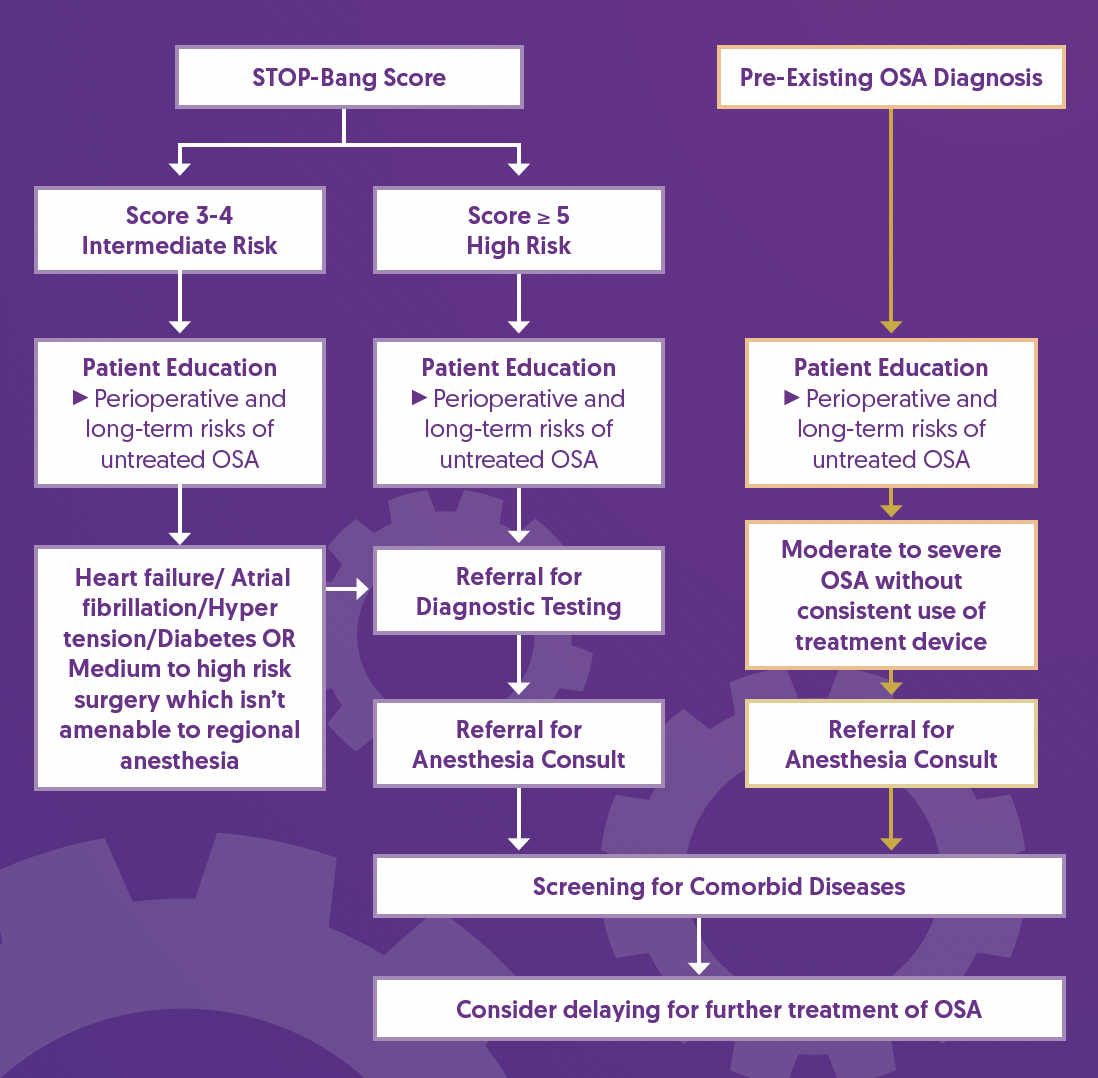
Patient Education
  • Counsel patients on the perioperative and long-term risks of untreated moderate or severe obstructive sleep apnea.
  • For pre-existing OSA diagnosis:
    • Instruct patient to continue using their treatment device (e.g., CPAP, BPAP, or dental device) until their surgery, and bring it to hospital, including for daycare surgery.
    • Request sleep study results from primary care provider if not available on electronic health record.
    • If patient is not using their treatment device as prescribed, emphasize the importance of its use in the postoperative period and suggest they follow up with their sleep clinic to discuss barriers to use and potential solutions.
Referral for Diagnostic Testing
  • Home Sleep Apnea Test (HSAT) (without Sleep Disorder Physician consultation)
    • See Form A for inclusion and exclusion criteria. This testing should be ordered by a physician who is responsible for the longitudinal care of a diagnosis of sleep apnea.
  • Sleep Disorder Consultation Referral
    • Sleep physicians will determine the appropriate testing modality and follow for therapy.
    • Use for patients that are not appropriate for HSAT
  • See online provider resources for referral templates
Referral for Anesthesia Consult
  • Consider referral in patients coming for moderate to severely invasive surgery, airway surgery, or those with severe OSA not compliant with CPAP.
  • To plan for postoperative management & monitoring to minimize OSA related perioperative complications.
Screening for Comorbid Disease
  • Obesity Hypoventilation Syndrome (see Obesity)
  • Diabetes
  • Cardiovascular / Respiratory complications
Consider delaying for further treatment of OSA
  • Made on a case by case basis taking into consideration:
    • Patient's overall health
    • Urgency of the surgery
    • Potential impact of untreated OSA on the surgical outcome
  • In the vast majority of cases there is insufficient evidence to support delaying surgery for testing/treatment unless there is evidence of significant or uncontrolled systemic disease or additional problems with ventilation or gas exchange. Continuation with surgery is reasonable if the patient is managed perioperatively as though they have untreated moderate to severe OSA. (9)

References

1. Roesslein, M., & Chung, F. (2018). Obstructive sleep apnoea in adults: peri-operative considerations: A narrative review. European journal of anaesthesiology, 35(4), 245–255. https://doi.org/10.1097/EJA.0000000000000765

2. Mutter, T. C., Chateau, D., Moffatt, M., Ramsey, C., Roos, L. L., & Kryger, M. (2014). A matched cohort study of postoperative outcomes in obstructive sleep apnea: could preoperative diagnosis and treatment prevent complications? Anesthesiology, 121(4), 707–718. https://doi.org/10.1097/ALN.0000000000000407

3. Abdelsattar, Z. M., Hendren, S., Wong, S. L., Campbell, D. A., Jr, & Ramachandran, S. K. (2015). The Impact of Untreated Obstructive Sleep Apnea on Cardiopulmonary Complications in General and Vascular Surgery: A Cohort Study. Sleep, 38(8), 1205–1210. https://doi.org/10.5665/sleep.4892

4. Patel, D., Tsang, J., Saripella, A., Nagappa, M., Islam, S., Englesakis, M., & Chung, F. (2022). Validation of the STOP questionnaire as a screening tool for OSA among different populations: a systematic review and meta-regression analysis. Journal of clinical sleep medicine : JCSM : official publication of the American Academy of Sleep Medicine, 18(5), 1441–1453. https://doi.org/10.5664/jcsm.9820

5. Melesse, D. Y., Mekonnen, Z. A., Kassahun, H. G., & Chekol, W. B. (2020). Evidence based perioperative optimization of patients with obstructive sleep apnea in Resource Limited Areas: A systematic review. International Journal of Surgery Open, 23, 23–34. https://doi.org/10.1016/j.ijso.2020.02.002

6. Cozowicz, C., & Memtsoudis, S. G. (2021). Perioperative Management of the Patient With Obstructive Sleep Apnea: A Narrative Review. Anesthesia and analgesia, 132(5), 1231–1243. https://doi.org/10.1213/ANE.0000000000005444

7. Chaudhry, R. A., Zarmer, L., West, K., & Chung, F. (2024). Obstructive Sleep Apnea and Risk of Postoperative Complications after Non-Cardiac Surgery. Journal of clinical medicine, 13(9), 2538. https://doi.org/10.3390/jcm13092538

8. Hwang, M., Nagappa, M., Guluzade, N., Saripella, A., Englesakis, M., & Chung, F. (2022). Validation of the STOP-Bang questionnaire as a preoperative screening tool for obstructive sleep apnea: a systematic review and meta-analysis. BMC anesthesiology, 22(1), 366. https://doi.org/10.1186/s12871-022-01912-1

9. Chung, F., Memtsoudis, S. G., Ramachandran, S. K., Nagappa, M., Opperer, M., Cozowicz, C., Patrawala, S., Lam, D., Kumar, A., Joshi, G. P., Fleetham, J., Ayas, N., Collop, N., Doufas, A. G., Eikermann, M., Englesakis, M., Gali, B., Gay, P., Hernandez, A. V., Kaw, R., … Auckley, D. (2016). Society of Anesthesia and Sleep Medicine Guidelines on Preoperative Screening and Assessment of Adult Patients With Obstructive Sleep Apnea. Anesthesia and analgesia, 123(2), 452–473. https://doi.org/10.1213/ANE.0000000000001416

10 Perioperative Management of OSA in Adults. 2025. Center for Perioperative Care. Royal College of Anesthesiologists.


Obesity Surgical Prehabilitation Toolkit for Healthcare Providers Pain Management
  • Printer-friendly version

Surgical Prehabilitation Toolkit

  • Anemia
  • Cardiac Risk
  • Delirium
  • Frailty
  • Glycemic Control
  • Goals of Care
  • Mental Wellbeing
  • Nutrition
  • Obesity
  • Obstructive Sleep Apnea
  • Pain Management
  • Physical Activity
  • Smoking Cessation
  • Substance Use - Alcohol
  • Substance Use - Cannabis
  • Substance Use - Illicit Substances
  • Support After Surgery

What’s New

Aug 11, 2026

Physician Quality Improvement: Celebrating Level 3 Cohort 8!

Photo of PQI alums at the Summit
Jul 16, 2026

Coming together for Physician Quality Improvement

Colourful artwork featuring an illustration of a narwhal and feather
Jun 1, 2026

Celebrating Indigenous culture: past, present, and future

Photo of doctor at a laptop
May 6, 2026

Transitioning off the Private Physician Network

View all News

About Us

  • Committee Members
  • Reports

SSC Fees

  • Advance Care Planning
  • Discharge Care Planning
  • Group Medical Visits (GMV)
  • Multidisciplinary Conferencing
  • Patient Follow-up Fees
  • Specialist Advice Fees
  • FAQs
  • Labour Market Adjustment Fees

News

  • Upcoming Events
  • SSC newsletters
  • Videos

General Contact

Specialist Services Committee
sscbc@doctorsofbc.ca
604-638-4853  

The land from which the Joint Collaborative Committees—a partnership between Doctors of BC and the BC government—operate and support physicians is the traditional territories of the Coast Salish peoples, including the xʷməθkʷəy̓əm (Musqueam), Sḵwx̱wú7mesh (Squamish), and səlilwətaɬ (Tsleil-Waututh) Nations, whose historical relationship with the land continues today.

For the Joint Collaborative Committees, acknowledging the land is an expression of cultural humility that involves recognizing our commitment to support the provision of culturally safe care to First Nations, Inuit, and Métis people in BC.

Government of BC   Doctors of BC

Specialist Services Committee © Doctors of BC

  • About Us
    • Committee Members
    • Reports
  • What We Do
    • Community Based Specialists
    • Consultant Specialist Team Care
    • Facility Engagement
    • Physician Quality Improvement Initiative
    • Physician Leadership Development
    • UBC Sauder Physician Leadership Program
    • Specialists Well-Being Pilot (SWELL)
    • Perioperative Clinical Action Network (PCAN)
    • SSC Fees
  • News
    • Upcoming Events
    • SSC newsletters
    • Videos
  • Contact
  • The Exchange
  • FE Knowledge Sharing
  • Main Menu
  • search