Postoperative delirium is one of the most common complications following major surgery, affecting 15025% of older adults undergoing major non-cardiac surgery. It is frequently under recognized, particularly the hypoactive subtype. Delirium is associated with increased complications, longer hospital stays, loss of independence, mortality, healthcare costs, and long-term cognitive and functional decline. (1-6)
Screening Tools
Identification of patients at increased risk of delirium is an important component of prevention, allowing targeted interventions to reduce postoperative delirium. The strongest risk factors include cognitive impairment, older age, and frailty. Other important risk factors include a history of delirium, visual or hearing impairment, substance dependence, social isolation, severe comorbid illness, and postoperative factors such as infection and medications (e.g., anticholinergics, opioids, and benzodiazepines). (7)
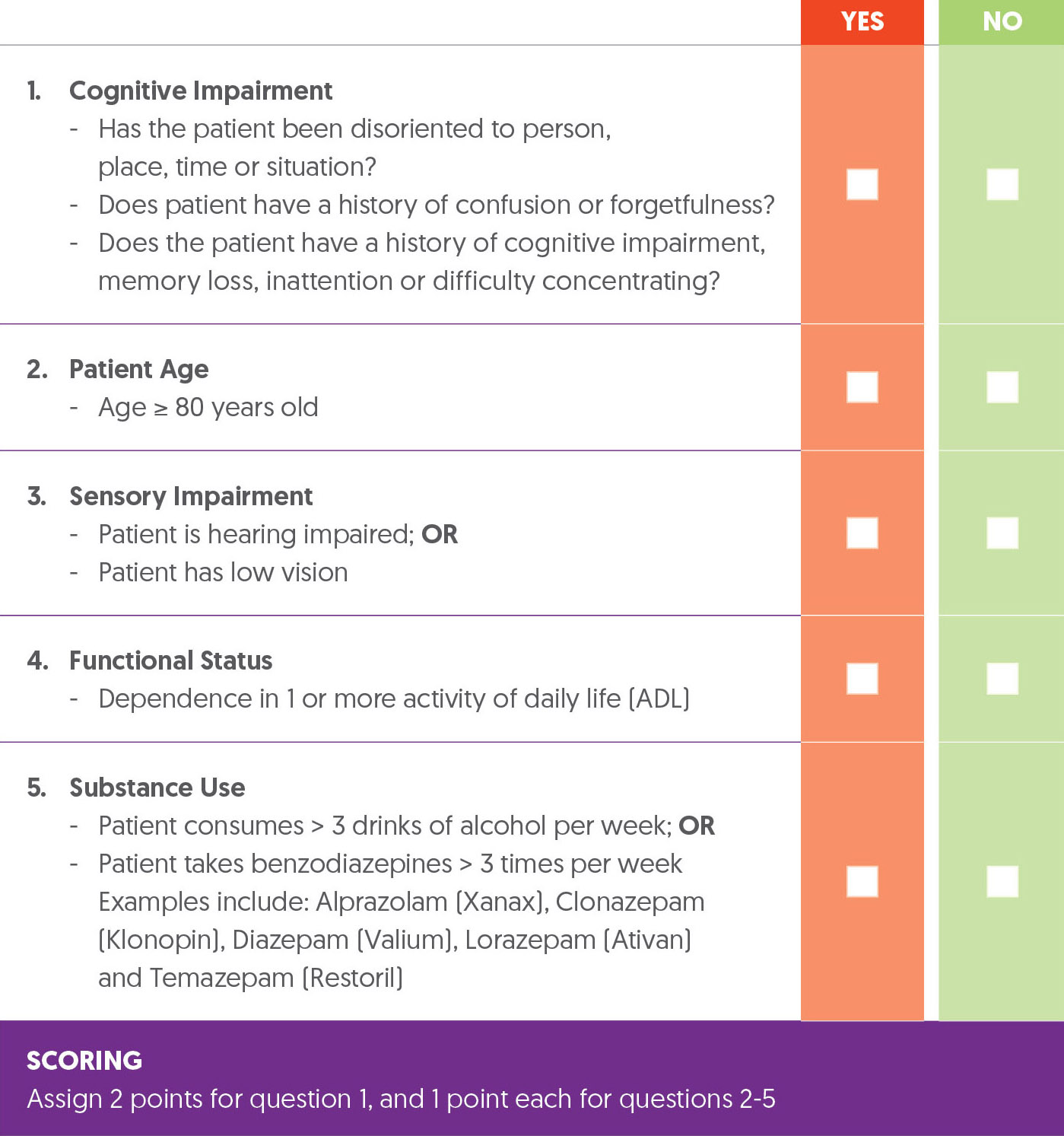
The modified Delirium Elderly At-Risk (mDEAR) tool is recommended as the preferred screening tool because it is the most evidence-supported instrument that can be completed using patient-reported information alone. It assesses cognitive impairment, age, functional dependence, sensory impairment, and chronic substance use, with a score of ≥3 indicating increased risk of postoperative delirium. (8)
Although the evidence supporting the mDEAR remains limited and other validated delirium risk assessment tools are available, these require cognitive testing or other clinician-administered assessments that cannot be incorporated into a standardized patient-completed questionnaire. The mDEAR therefore represents the most practical option for province-wide preoperative screening while recognizing that clinical judgment should always complement screening results when assessing an individual's risk of postoperative delirium.
mDEAR Screening Instrument
Prehabilitation and Optimization Algorithm
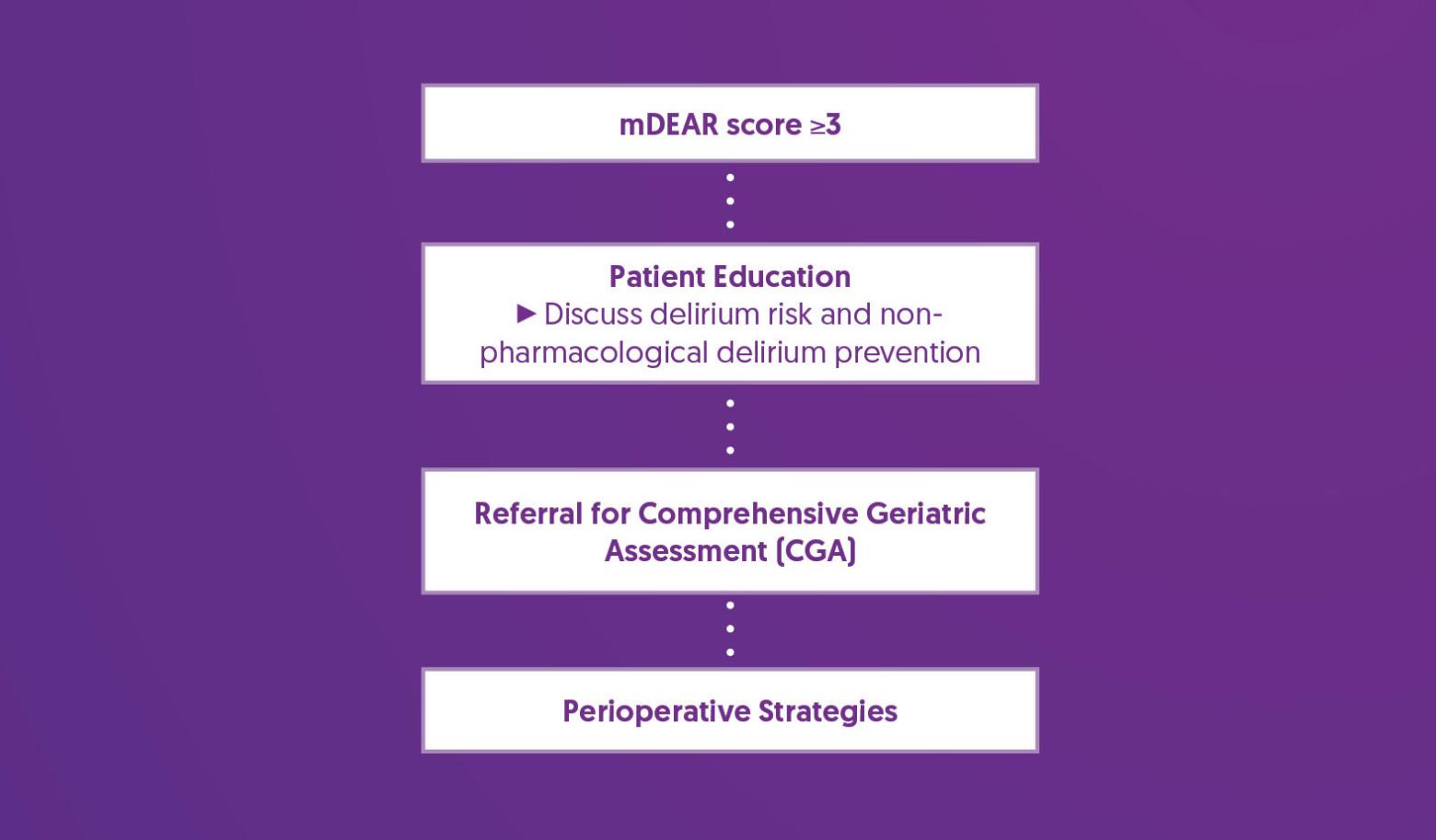
Prehabilitation and Optimization Recommendations
| Patient Education |
|
| Referral for Comprehensive Geriatric Assessment (CGA) |
|
| Perioperative Strategies |
|
References
1. Freter, S. H. (2005). Predicting post-operative delirium in elective orthopaedic patients: The Delirium Elderly At-Risk (DEAR) instrument. Age and Ageing, 34(2), 169–171. https://doi.org/10.1093/ageing/afh245
2. Freter, S., Dunbar, M., Koller, K., MacKnight, C., & Rockwood, K. (2015). Risk of Pre-and Post-Operative Delirium and the Delirium Elderly At Risk (DEAR) Tool in Hip Fracture Patients. Canadian geriatrics journal : CGJ, 18(4), 212–216. https://doi.org/10.5770/cgj.18.185
3. Zywiel, M. G., Hurley, R. T., Perruccio, A. V., Hancock-Howard, R. L., Coyte, P. C., & Rampersaud, Y. R. (2015). Health economic implications of perioperative delirium in older patients after surgery for a fragility hip fracture. The Journal of bone and joint surgery. American volume, 97(10), 829–836. https://doi.org/10.2106/JBJS.N.00724
4. Yan, E., Veitch, M., Saripella, A., Alhamdah, Y., Butris, N., Tang-Wai, D. F., Tartaglia, M. C., Nagappa, M., Englesakis, M., He, D., & Chung, F. (2023). Association between postoperative delirium and adverse outcomes in older surgical patients: A systematic review and meta-analysis. Journal of Clinical Anesthesia, 90, 111221. https://doi.org/10.1016/j.jclinane.2023.111221
5. Numan, T., van den Boogaard, M., Kamper, A. M., Rood, P. J. T., Peelen, L. M., Slooter, A. J. C., & Dutch Delirium Detection Study Group (2017). Recognition of Delirium in Postoperative Elderly Patients: A Multicenter Study. Journal of the American Geriatrics Society, 65(9), 1932–1938. https://doi.org/10.1111/jgs.14933
6. Lander, H. L., Dick, A. W., Joynt Maddox, K. E., Oldham, M. A., Fleisher, L. A., Mazzeffi, M., Lustik, S. J., Shang, J., Stone, P. W., Gloff, M. S., Nadler, J., Wu, I., Zollo, R., & Glance, L. G. (2025). Postoperative Delirium in Older Adults Undergoing Noncardiac Surgery. JAMA network open, 8(7), e2519467. https://doi.org/10.1001/jamanetworkopen.2025.19467
7. Mahanna-Gabrielli, E., Schenning, K. J., Eriksson, L. I., Browndyke, J. N., Wright, C. B., Culley, D. J., Evered, L., Scott, D. A., Wang, N. Y., Brown, C. H., 4th, Oh, E., Purdon, P., Inouye, S., Berger, M., Whittington, R. A., Price, C. C., & Deiner, S. (2019). State of the clinical science of perioperative brain health: report from the American Society of Anesthesiologists Brain Health Initiative Summit 2018. British journal of anaesthesia, 123(4), 464–478. https://doi.org/10.1016/j.bja.2019.07.004
8. Meehan, A. J., Gabra, J. N., Whyde, C. (2023). Development and validation of a delirium risk prediction model using a modified version of the Delirium Eldery at Risk (mDEAR) screen in hospitalized patients aged 65 and older: A medical record review. Geriatric Nursing, 51, 150-155.https://doi.org/10.1016/j.gerinurse.2023.03.003
9. Jin, Z., Hu, J., & Ma, D. (2020). Postoperative delirium: perioperative assessment, risk reduction, and management. British journal of anaesthesia, 125(4), 492–504. https://doi.org/10.1016/j.bja.2020.06.063
10. Marcantonio, E. R., Ngo, L. H., O'Connor, M., Jones, R. N., Crane, P. K., Metzger, E. D., & Inouye, S. K. (2014). 3D-CAM: derivation and validation of a 3-minute diagnostic interview for CAM-defined delirium: a cross-sectional diagnostic test study. Annals of internal medicine, 161(8), 554–561. https://doi.org/10.7326/M14-0865
11. Chen, C. C., Li, H. C., Liang, J. T., Lai, I. R., Purnomo, J. D. T., Yang, Y. T., Lin, B. R., Huang, J., Yang, C. Y., Tien, Y. W., Chen, C. N., Lin, M. T., Huang, G. H., & Inouye, S. K. (2017). Effect of a Modified Hospital Elder Life Program on Delirium and Length of Hospital Stay in Patients Undergoing Abdominal Surgery: A Cluster Randomized Clinical Trial. JAMA surgery, 152(9), 827–834. https://doi.org/10.1001/jamasurg.2017.1083
12. Fan, G., Zhong, M., Su, W., An, Z., Zhu, Y., Chen, C., Dong, L., Wu, L., & Zhang, X. (2024). Effect of different anesthetic modalities on postoperative delirium in elderly hip fractures: A meta-analysis. Medicine, 103(23), e38418. https://doi.org/10.1097/MD.0000000000038418
13. Huang, J. X., Zhang, S. S., Wang, S. X., Xi, D. S., Luo, F. R., Liu, C. J., & Li, H. (2024). The role of perioperative sedative anesthetics in preventing postoperative delirium: a systematic review and network-meta analysis including 6679 patients. BMC cardiovascular disorders, 24(1), 147. https://doi.org/10.1186/s12872-024-03783-5
14. Deschamps, A., Ben Abdallah, A., Jacobsohn, E., Saha, T., Djaiani, G., El-Gabalawy, R., Overbeek, C., Palermo, J., Courbe, A., Cloutier, I., Tanzola, R., Kronzer, A., Fritz, B. A., Schmitt, E. M., Inouye, S. K., Avidan, M. S., & Canadian Perioperative Anesthesia Clinical Trials Group (2024). Electroencephalography-Guided Anesthesia and Delirium in Older Adults After Cardiac Surgery: The ENGAGES-Canada Randomized Clinical Trial. JAMA, 332(2), 112–123. https://doi.org/10.1001/jama.2024.8144
15. Nikooie, R., Neufeld, K. J., Oh, E. S., Wilson, L. M., Zhang, A., Robinson, K. A., & Needham, D. M. (2019). Antipsychotics for Treating Delirium in Hospitalized Adults: A Systematic Review. Annals of internal medicine, 171(7), 485–495. https://doi.org/10.7326/M19-1860