Jump to Navigation

What can we help you find today? Type what you’re looking for in the space below.

Close
  • About Us
    • Committee Members
    • Reports
  • What We Do
    • Community Based Specialists
    • Consultant Specialist Team Care
    • Facility Engagement
    • Physician Quality Improvement Initiative
    • Physician Leadership Development
    • UBC Sauder Physician Leadership Program
    • Specialists Well-Being Pilot (SWELL)
    • Perioperative Clinical Action Network (PCAN)
    • SSC Fees
  • News
    • Upcoming Events
    • SSC newsletters
    • Videos
  • Contact
  • The Exchange
  • FE Knowledge Sharing
  • Main Menu
  • search

Nutrition

Malnutrition is present in approximately 45% of patients at time of admission to hospital. It is often underrecognized and is associated with increased postoperative complications and in-hospital and 30-day mortality. Nutrition risk is also associated with increased length of stay, readmission, and hospital costs. (1-5) Preoperative & early postoperative nutritional intervention are associated with improvements in postoperative complications and mortality. (6)

Screening Tools

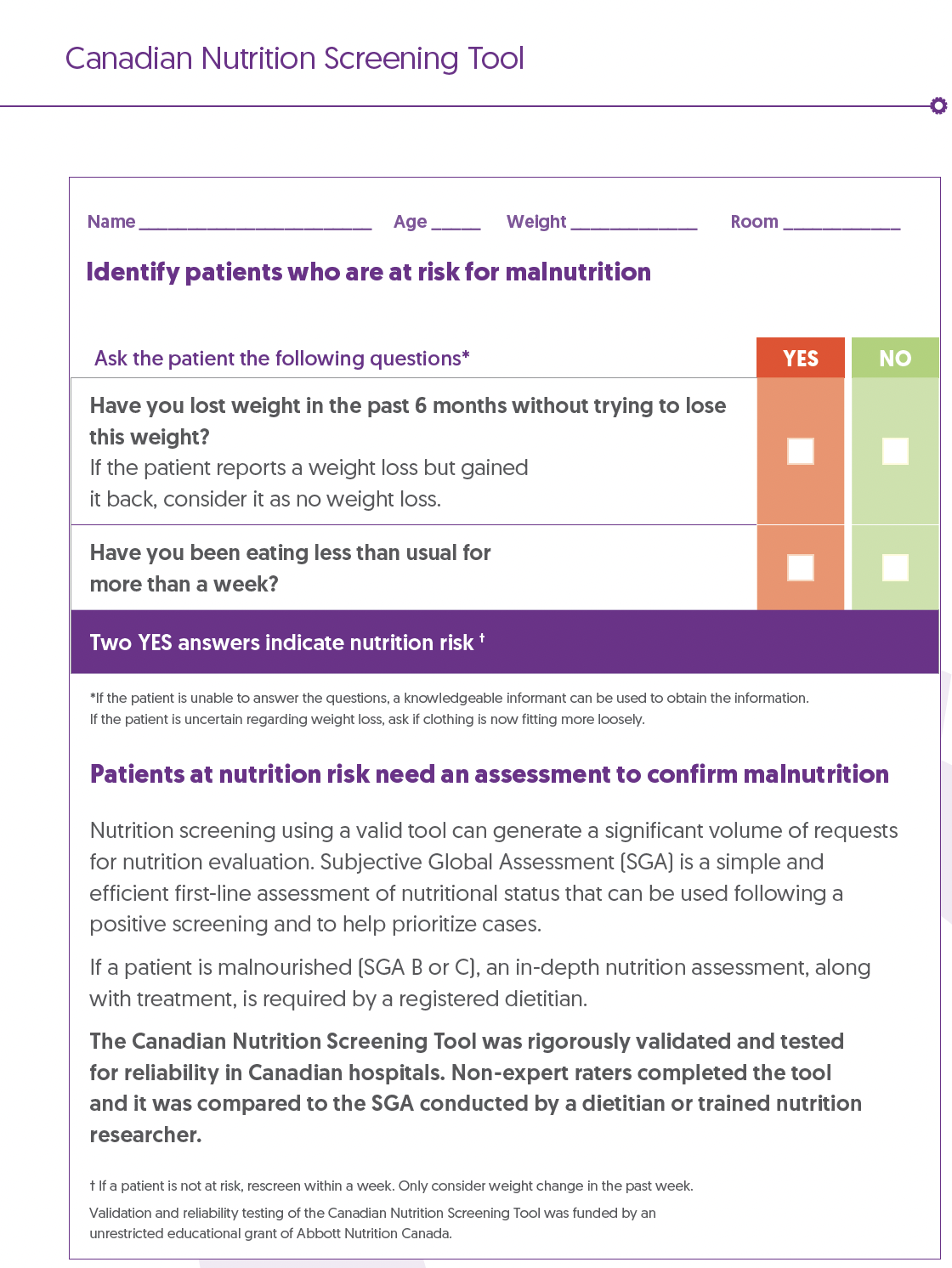
The Canadian Nutrition Screening Tool (CNST) is a valid and reliable screening tool to identify those patients at risk of malnutrition in the adult acute care environment. (1)
Prehabilitation and Optimization Algorithm
Prehabilitation and Optimization Recommendations

Patient Education
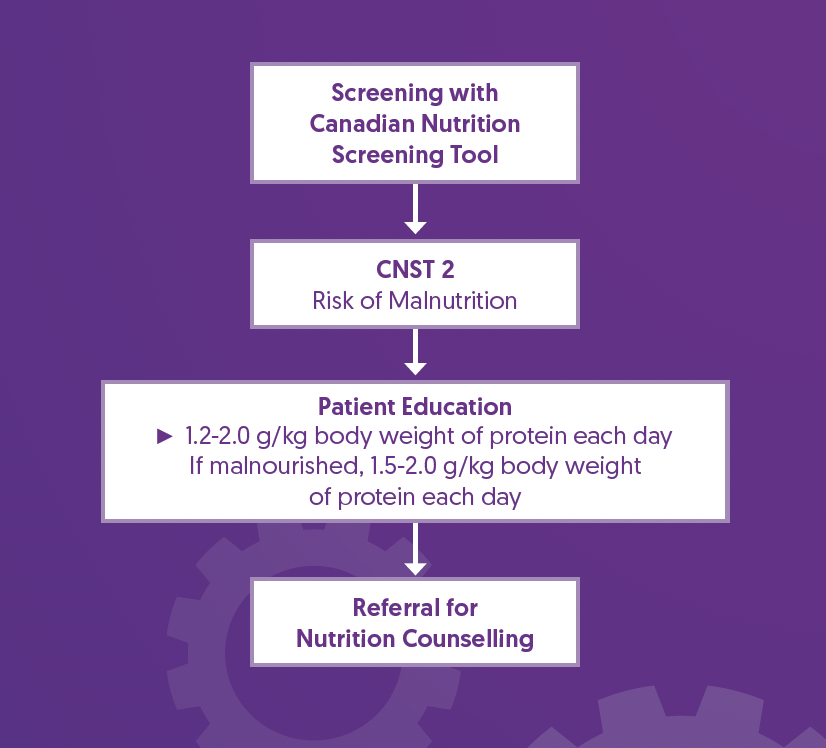
  • Patients with a CNST score of 2 are at high risk for malnutrition and require dietician assessment. It is essential that the patient is able to meet their carbohydrate and protein needs prior to surgery. For 2-4 weeks prior to surgery an increase in dietary protein (aiming for 1.2-2 g/kg/day) may be recommended. (9) If individual is malnourished, total protein increases to 1.5-2.0 g/kg/day (10).
  • Refer to online patient resources
Referral for Nutrition Counseling
  • Dietician to assess for malnutrition and provide a plan to optimize nutrition before surgery
  • Refer to online provider resources for dietician resources and referral templates

References

1. Laporte, M., Keller, H. H., Payette, H., Allard, J. P., Duerksen, D. R., Bernier, P., Jeejeebhoy, K., Gramlich, L., Davidson, B., Vesnaver, E., & Teterina, A. (2015). Validity and reliability of the new Canadian Nutrition Screening Tool in the 'real-world' hospital setting. European journal of clinical nutrition, 69(5), 558–564. https://doi.org/10.1038/ejcn.2014.270

2. Wong, H. M. K., Qi, D., Ma, B. H. M., Hou, P. Y., Kwong, C. K. W., Lee, A., & Prehab Study Group (2024). Multidisciplinary prehabilitation to improve frailty and functional capacity in high-risk elective surgical patients: a retrospective pilot study. Perioperative medicine (London, England), 13(1), 6. https://doi.org/10.1186/s13741-024-00359-x

3. Duerksen, D. R., Keller, H. H., Vesnaver, E., Laporte, M., Jeejeebhoy, K., Payette, H., Gramlich, L., Bernier, P., & Allard, J. P. (2016). Nurses' Perceptions Regarding the Prevalence, Detection, and Causes of Malnutrition in Canadian Hospitals: Results of a Canadian Malnutrition Task Force Survey. JPEN. Journal of parenteral and enteral nutrition, 40(1), 100–106. https://doi.org/10.1177/0148607114548227

4. Duerksen, D. R., Keller, H. H., Vesnaver, E., Allard, J. P., Bernier, P., Gramlich, L., Payette, H., Laporte, M., & Jeejeebhoy, K. (2015). Physicians' perceptions regarding the detection and management of malnutrition in Canadian hospitals: results of a Canadian Malnutrition Task Force survey. JPEN. Journal of parenteral and enteral nutrition, 39(4), 410–417. https://doi.org/10.1177/0148607114534731

5. Allard, J. P., Keller, H., Jeejeebhoy, K. N., Laporte, M., Duerksen, D. R., Gramlich, L., Payette, H., Bernier, P., Vesnaver, E., Davidson, B., Teterina, A., & Lou, W. (2016). Malnutrition at Hospital Admission-Contributors and Effect on Length of Stay: A Prospective Cohort Study From the Canadian Malnutrition Task Force. JPEN. Journal of parenteral and enteral nutrition, 40(4), 487–497. https://doi.org/10.1177/0148607114567902

6. Impact of malnutrition on early outcomes after cancer surgery: an international, multicentre, prospective cohort study

7. Martínez-Ortega, A. J., Piñar-Gutiérrez, A., Serrano-Aguayo, P., González-Navarro, I., Remón-Ruíz, P. J., Pereira-Cunill, J. L., & García-Luna, P. P. (2022). Perioperative Nutritional Support: A Review of Current Literature. Nutrients, 14(8), 1601. https://doi.org/10.3390/nu14081601

8. Gillis, C. and Weimann, A. (2025). Prehabilitation in surgery - an update with a focus on nutrition. Curr Opin Clin Nutr Metab Care. 28(3), 224-234.

9. Gillis, C. and Wischmeyer, P.E. (2019). Pre-operative nutrition and the elective surgical patient: why, how and what? Anesthesia, 74(Suppl.1), 27-35.

10. Durrand J., Singh, SJ., Danjoux, G., (2019). Prehabilitation. Clin Med (Lond). 19(6), 458-464.


Mental Wellbeing Surgical Prehabilitation Toolkit for Healthcare Providers Obesity
  • Printer-friendly version

Surgical Prehabilitation Toolkit

  • Anemia
  • Cardiac Risk
  • Delirium
  • Frailty
  • Glycemic Control
  • Goals of Care
  • Mental Wellbeing
  • Nutrition
  • Obesity
  • Obstructive Sleep Apnea
  • Pain Management
  • Physical Activity
  • Smoking Cessation
  • Substance Use - Alcohol
  • Substance Use - Cannabis
  • Substance Use - Illicit Substances
  • Support After Surgery

What’s New

Aug 11, 2026

Physician Quality Improvement: Celebrating Level 3 Cohort 8!

Photo of PQI alums at the Summit
Jul 16, 2026

Coming together for Physician Quality Improvement

Colourful artwork featuring an illustration of a narwhal and feather
Jun 1, 2026

Celebrating Indigenous culture: past, present, and future

Photo of doctor at a laptop
May 6, 2026

Transitioning off the Private Physician Network

View all News

About Us

  • Committee Members
  • Reports

SSC Fees

  • Advance Care Planning
  • Discharge Care Planning
  • Group Medical Visits (GMV)
  • Multidisciplinary Conferencing
  • Patient Follow-up Fees
  • Specialist Advice Fees
  • FAQs
  • Labour Market Adjustment Fees

News

  • Upcoming Events
  • SSC newsletters
  • Videos

General Contact

Specialist Services Committee
sscbc@doctorsofbc.ca
604-638-4853  

The land from which the Joint Collaborative Committees—a partnership between Doctors of BC and the BC government—operate and support physicians is the traditional territories of the Coast Salish peoples, including the xʷməθkʷəy̓əm (Musqueam), Sḵwx̱wú7mesh (Squamish), and səlilwətaɬ (Tsleil-Waututh) Nations, whose historical relationship with the land continues today.

For the Joint Collaborative Committees, acknowledging the land is an expression of cultural humility that involves recognizing our commitment to support the provision of culturally safe care to First Nations, Inuit, and Métis people in BC.

Government of BC   Doctors of BC

Specialist Services Committee © Doctors of BC

  • About Us
    • Committee Members
    • Reports
  • What We Do
    • Community Based Specialists
    • Consultant Specialist Team Care
    • Facility Engagement
    • Physician Quality Improvement Initiative
    • Physician Leadership Development
    • UBC Sauder Physician Leadership Program
    • Specialists Well-Being Pilot (SWELL)
    • Perioperative Clinical Action Network (PCAN)
    • SSC Fees
  • News
    • Upcoming Events
    • SSC newsletters
    • Videos
  • Contact
  • The Exchange
  • FE Knowledge Sharing
  • Main Menu
  • search