Posted on Feb 15, 2019
The expression “getting old is not for the faint-of-heart” really comes to life when visiting any long-term care (LTC) facility. These LTC residents face many challenges. In fact, over 70 percent of Interior Health’s approximately 5,400 LTC residents have brain disorders and related psychiatric symptoms. Dr Carol Ward, Geriatric Psychiatrist in Kamloops approached SSC to fund a project that would help provide appropriate and timely mental health services to these older adults.
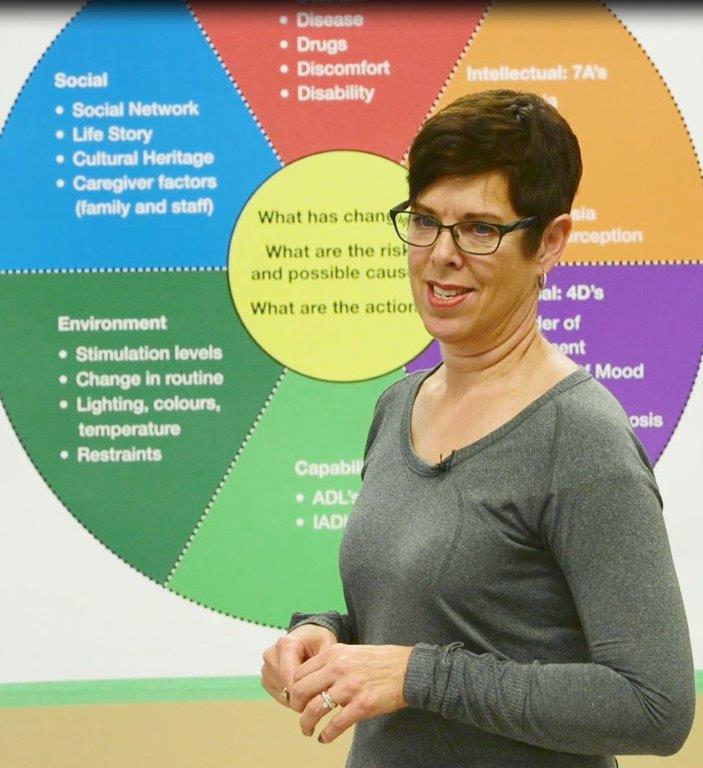
The project demonstrated the need for Regional Knowledge Coordinators-Complex Behaviours (RKC), who are either a psychiatric nurse or a nurse with experience in seniors’ mental health. RKCs support LTC sites with expertise – they are building capacity for care through consultations, site visits, direct teaching and promotion of training supports, such as P.I.E.C.E.S.™, Gentle Persuasive Approach BC BPSD Algorithm, and more.
RKCs educating and mentoring on a person-centered Behavioural Care Plan, which includes non-pharmacologic strategies ensures a comprehensive approach that fits best for the resident. RKCs also become involved when there are escalating changes in behaviour or complex medical issues, and when appropriate, recommend referrals to a psychiatrist.
Patient outcomes include an 88 percent improvement in their Cohen-Mansfield Agitation Inventory scale, which is a 29-item psychological scale that systematically assesses agitation. As well, there was a 10 percent decrease in incidents that cause harm and 20 percent difference in admissions to geriatric psychiatry program at a tertiary psychiatry hospital.
In addition, with limited geriatric psychiatric services, Dr Ward recognized the important role family physicians play in providing care. Through surveys – it was found that family physicians lack confidence in their knowledge of dementia and in caring for residents with complex behaviours.
Dr Ward notes, “We had some pretty significant metrics to show for our efforts.” Patient outcomes identified that 88 percent of those receiving RKC-CB behavioural liaison improved in their Cohen-Mansfield Agitation Inventory scale, which is a 29-item scale that systematically assesses agitation. As well, there was a 20 percent decrease in ED visits and a 15% decrease in admission from ED due to mental health reasons or behaviours. There was also a decrease in serious harm events as recorded in PSLS.
Together with her colleagues, Dr Elizabeth Drance and Dr Barbara Prystawa– they proceeded to deliver an accredited workshop “Dementia-related Responsive Behaviour: Putting It All Together Using P.I.E.C.E.S.™ and the BC BPSD Algorithm” to 93 family physicians in Interior Health.
This training is now being developed as an online tool to be available early next year. It was also determined that rural physicians and nurse practitioners needed education and support – a pilot called Project ECHO is being developed for delivery in the new year. For more detailed information, please contact sscbc@doctorsofbc.ca
Read more about this project here on The Daily Courier.